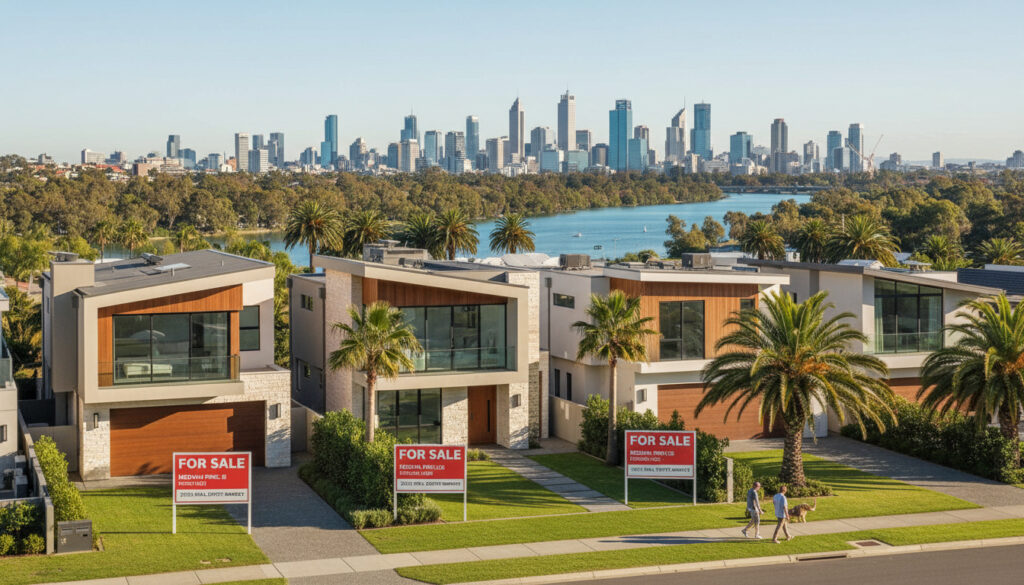
Houses for Sale Perth – Median $786k and Top Suburbs 2025
Perth’s residential property market has experienced unprecedented price escalation through 2024 and into 2025, with the median house price reaching $786,000 by the conclusion of the 2024-25 financial year, according to REIWA data. This figure represents a 16.4% annual increase, positioning the Western Australian capital as one of Australia’s fastest-appreciating metropolitan markets.
The acceleration builds upon momentum established during 2024, when median values surged between 24.2% and 25% year-on-year depending on property classification. House prices peaked at 25.0% annual growth in December 2024, while unit values reached 22.9% growth by January 2025, with the median unit price hitting $540,000.
Buyers currently navigating the market encounter markedly reduced inventory levels compared to historical norms, with listings having contracted significantly from peaks exceeding 7,000 properties. This supply constraint, coupled with sustained interstate migration and rental vacancy rates of 2.8%, continues to place upward pressure on values across the metropolitan area.
How Much Do Houses Cost in Perth?
| Current Median $786,000 (16.4% annual growth) |
Fastest-Growing Suburbs Marmion, West Perth, Beaconsfield |
| Most Sought-After Type 4-bedroom family homes |
Market Velocity 9-35 days median on market |
- Annual growth of 16.4% outperforms most Australian capital cities
- Unit medians reached $540,000, representing 20% annual appreciation
- Regional WA outperformed metropolitan Perth with 14.7% annual growth
- Rental yields remain attractive at 4.1% for houses and 5.0% for units
- 48,793 settled sales recorded during the 2024-25 financial year
- Interstate migration continues driving demand beyond local supply
- Inventory shortages persist with active listings well below 7,000 properties
| Period | Median House Price | Growth Rate | Source |
|---|---|---|---|
| End 2023 | $625,000 | +13.6% yearly | Contessi Research |
| Q1 2024 | ~$650,000 | +4.2% quarterly | Champion Broker |
| Dec 2024 | $745,000-$850,000 | +24.2% YoY | You & Me PPS |
| FY 2024-25 | $786,000 | +16.4% annual | REIWA |
| Mar 2025 | $770,000 | +2.7% quarterly | Candcore Real Estate |
| Units FY 2024-25 | $540,000 | +20.0% annual | REIWA |
What Are the Best Suburbs for Houses in Perth?
Northern Coastal Premium Markets
Marmion recorded exceptional growth of 55.3% to reach a median of $2.17 million, while Trigg and North Beach demonstrated similarly robust performance. These northern beachfront localities have attracted significant buyer interest due to lifestyle amenities and limited available stock, with medians exceeding $1 million across the coastal strip.
Cottesloe maintains its position among the premium coastal markets, though specific 2025 growth percentages remain less documented than northern counterparts. The concentration of high-value transactions in these postcodes reflects sustained demand for ocean-adjacent living.
Emerging Growth Corridors
West Perth appreciated 48.9% to reach $1.34 million, while Riverton posted 39.7% growth during the 2024-25 period. More recently, Coolbellup and Hamilton Hill have emerged as 2025 standouts, recording 23.4% and 22% growth respectively, with medians of $770,000 and $842,000.
Entry-Level Opportunities
Gosnells presents one of the few remaining sub-$500,000 entry points for units at $435,000, following 52.6% annual growth. Houses under $500,000 have become increasingly scarce following the market’s rapid appreciation from the $625,000 baseline recorded at the end of 2023, though outer suburban pockets may offer limited established options for budget-constrained buyers.
Beaconsfield recorded 30.4% growth to reach $1.2 million in early 2025, indicating that price appreciation has extended beyond traditional premium coastal postcodes into inner-city fringe locations previously considered more accessible.
What New and Popular Houses Are for Sale in Perth?
Family-Sized Residences
Demand for four-bedroom family homes concentrates on established properties rather than new builds, given construction constraints and limited development land in established areas. These properties typically command premiums aligned with the metropolitan median growth patterns, with buyers prioritizing proximity to schools and transport over new construction.
Waterfront and Coastal Inventory
Coastal localities including Cottesloe and beachfront stretches of the northern suburbs dominate the premium segment, with Marmion’s $2.17 million median reflecting the scarcity of ocean-adjacent listings. Waterfront properties command significant premiums compared to inland alternatives, with lifestyle factors driving competition among high-net-worth purchasers.
Outer Suburban Developments
New housing stock concentrates in peripheral suburbs where development land remains available. These areas have attracted investor interest from eastern states buyers seeking rental yields of 4.1% for houses and 5.0% for units, following rental price increases of 19.8% recorded prior to 2024.
Is It a Good Time to Buy a House in Perth?
Market velocity remains elevated, with properties selling within 9 to 35 days on average, significantly faster than historical norms. Government incentives for first-home buyers continue to support entry-level demand, complementing the existing pressure from interstate migration and tight rental markets.
Forecasters predicted approximately 10% growth for 2025, though early 2024 projections varied widely from 5.2% to 20% annual increases. The actual 16.4% growth for FY 2024-25 exceeded conservative estimates, suggesting market conditions remain favorable for sellers while challenging for buyers seeking value.
Rental yields of 4.1% for houses and 5.0% for units, combined with sustained capital appreciation, suggest continued investor interest despite rapid price escalation. Regional WA’s 14.7% growth outperformed even metropolitan Perth’s strong showing.
Listings remain critically low heading into 2025, with no immediate indication of significant inventory increases that might moderate the competitive pressure driving price growth.
How Has the Perth Housing Market Changed Over Recent Years?
- : Median house price baseline established at $625,000 following 13.6% yearly growth.
- : Forecasts projected quarterly growth of 4.2%, with annual predictions ranging from 5.2% to 20%.
- : Median values reached $745,000-$850,000 amid 24.2% year-on-year expansion.
- : Unit prices peaked at 22.9% annual growth according to REIWA data.
- : Median house price recorded at $770,000, representing 2.7% quarterly growth from December’s $750,000 baseline.
- : Financial year concluded with median house price at $786,000 and 48,793 settled sales.
What Is Certain and What Remains Uncertain About Perth’s Market?
| Established Information | Information That Remains Uncertain |
|---|---|
| Median house price reached $786,000 by end of FY 2024-25 | Exact trajectory of interest rate impacts on borrowing capacity |
| 48,793 settled sales recorded in FY 2024-25 | Whether listing volumes will recover from current lows below 7,000 |
| Rental vacancy rate at 2.8% | Specific timing of potential market moderation from current growth rates |
| Regional WA outperformed metro with 14.7% growth | Long-term sustainability of 20%+ annual growth rates |
| Days on market contracted to 9-35 days | Impact of potential interstate migration slowdown on demand |
What Economic Factors Are Shaping Perth’s Property Landscape?
Population growth through interstate migration has fundamentally altered demand dynamics, while construction constraints limit new supply. Regional WA outperformed the metropolitan area with 14.7% annual growth, suggesting the boom extends beyond the capital’s boundaries.
The rental market’s 19.8% price increases heading into 2024 established yield conditions that attracted investor capital, with current returns remaining competitive nationally. Supply shortages persist with active listings having contracted from peaks exceeding 7,000 properties, creating competitive conditions for available stock. Life as a House – Plot Cast and Ending Explained offers narrative context on housing challenges, though buyers focus instead on empirical data showing consistent quarterly appreciation.
What Do Industry Data Sources Indicate?
“Perth’s top-performing suburbs for 2024-25 demonstrate that coastal and lifestyle locations continue driving exceptional value growth, with some beachfront postcodes exceeding 50% annual appreciation.”
— REIWA Market Analysis
“The 2024-25 financial year concluded with 48,793 settled sales, indicating transaction volumes remain robust despite price escalation and limited inventory.”
— Champion Broker Market Forecast
What Key Points Should Buyers Consider?
Prospective purchasers face a market characterized by $786,000 median house prices, compressed marketing periods of 9-35 days, and historically low inventory levels. While northern suburbs and coastal locations command premium prices, emerging areas like Coolbellup and Hamilton Hill offer relative value despite 20%+ growth. Kmart Bath Mat – Australia’s Limited Options Analyzed illustrates how availability constraints affect diverse consumer markets, yet serious buyers must prioritize pre-approval and immediate responsiveness to new listings given current velocity.
Frequently Asked Questions
What defines the current houses for sale in Perth market?
The market features 48,793 annual sales, $786,000 median house prices, and 9-35 day selling periods, characterized by supply shortages and strong interstate migration.
How can buyers find properties under $500,000?
Gosnells units at $435,000 represent rare sub-$500k entry points, though houses under this threshold have become scarce following the 2024-25 price appreciation.
Which suburbs show strongest growth?
Marmion (+55.3%), West Perth (+48.9%), and Beaconsfield (+30.4%) lead price appreciation, with Coolbellup and Hamilton Hill showing 2025 momentum.
What rental yields can investors expect?
Houses yield 4.1% and units 5.0%, following 19.8% rental price growth pre-2024, with regional WA outperforming at 14.7% capital growth.
How quickly are properties selling?
Median days on market range from 9 to 35 days, significantly faster than historical averages, requiring buyer preparedness.
What drives Perth’s price growth?
Interstate migration, 2.8% rental vacancy rates, and supply constraints from listings below 7,000 properties sustain upward pressure.
Are new houses available?
New stock concentrates in outer suburbs with development land, often targeting investor buyers from eastern states.
What was the median price trajectory?
Prices rose from $625,000 (end 2023) to $786,000 (FY 2024-25), with March 2025 at $770,000 following quarterly growth.
More related posts
 Jane Bunn: Career, Weight Loss, Husband, Background
 Allison Williams: Biography, Husband, Movies, and FAQs
 Sony Cyber Shot – History, Best Models and Availability
 Aluminium vs uPVC Sliding Doors: Irish Homeowner Guide
 Anna Torv: Biography, Look-Alikes, and Career Facts
 Spider-Man: Beyond the Spider-Verse Release Date, Delay & FAQ
 Jessica Osbourne: Why She Skipped Ozzy’s Funeral, Private Life