Zoho Mail Login – Step-by-Step Guide and Troubleshooting
Accessing Zoho Mail requires navigating to the official entry point and providing valid authentication credentials. The platform supports multiple verification methods, including standard password entry and enhanced two-factor authentication protocols for organizational security.
Users encounter varying login procedures depending on device type and administrative settings. Mobile applications, web browsers, and external email clients each present distinct authentication flows, particularly when administrators enable mandatory secondary verification protocols.
The security infrastructure emphasizes protection against unauthorized access through application-specific passwords and biometric alternatives. Zoho documentation highlights these mechanisms as essential safeguards for business communications.
How Do I Login to Zoho Mail?
mail.zoho.com
Valid email address, password, supported browser
Web browser, mobile application, SSO integration
Two-factor authentication recommended
- Direct URL entry remains the fastest access method for web users.
- Two-factor authentication adds a mandatory verification step when enabled by administrators or individual users.
- Mobile applications support offline OTP generation through Zoho OneAuth.
- External email clients require application-specific passwords when TFA is active.
- Administrators retain override capabilities for organizational security resets.
- Passphrase recovery options exist within OneAuth to prevent lockouts.
- Unrecognized devices trigger additional authorization requirements automatically.
| Aspect | Details |
|---|---|
| Primary Access URL | mail.zoho.com |
| Base Credentials | Username and password |
| TFA Delivery Methods | SMS, voice call, QR code |
| Mobile Verification | Secure code via SMS, voice, or linked QR app |
| External Client Access | 12-digit application-specific password required |
| Admin Control Location | Security and Compliance > TFA |
| Backup Recovery | Cloud backup and passphrase options (OneAuth) |
| TFA Reset Authority | Administrators via Admin Console |
Common Zoho Mail Login Problems and Fixes
Authentication failures often stem from secondary verification complications rather than primary password errors. Users accessing accounts from new devices or locations encounter additional security layers that may block entry if not properly configured.
Recovering Access When Two-Factor Authentication Fails
Device loss presents significant access barriers for users with active TFA. Zoho Mail administrators possess reset capabilities through the Admin Console, navigating to specific user profiles within the Security settings to revoke and refresh two-factor requirements. Official documentation confirms this process requires administrative re-authentication before the affected user can establish fresh verification modes.
Application-Specific Password Complications
External email clients attempting standard password authentication fail when organizational TFA policies are active. These integrations require 12-digit application-specific passwords generated through the Zoho Accounts security panel. Each password displays only once during generation, necessitating immediate entry without spaces into the third-party client configuration.
Losing the mobile device configured for TFA prevents personal account recovery without administrative intervention. Individual users cannot self-reset two-factor authentication once enabled.
How to Login to Zoho Mail with Google or on Mobile
Mobile access diverges from standard web protocols through specialized applications and authentication handlers. Zoho OneAuth serves as the primary multi-factor tool, offering OTP generation for both Zoho and non-Zoho accounts alongside cloud backup functionality.
Mobile Application Authentication Flow
The mobile login sequence requires username and password entry followed by secure code verification. Users receive these codes via SMS, voice call, or through QR code applications linked during initial setup. OneAuth provides alternate verification modes including direct QR code scanning and offline OTP generation, alongside passphrase recovery options for lockout prevention.
Single Sign-On Integration
While specific Google SSO technical integration details remain undocumented in reviewed materials, enterprise users typically access administrative functions through the Zoho Mail Admin Console. This centralized security hub manages organization-wide TFA policies and user-specific authentication resets. OLED vs QLED – 2025 Comparison Guide provides additional context on interface authentication technologies.
Resetting Zoho Mail Password and Security Tips
Security maintenance requires understanding both administrative overrides and application-specific credential generation. Organizations enforce varying authentication standards that affect how end-users manage access credentials.
Enabling Organization-Wide Protection
Administrators activate mandatory two-factor authentication through the Security and Compliance panel, specifically within the TFA subsection. Activation requires immediate re-authentication to verify identity, after which all organization members must configure secondary verification. Individual users retain the ability to enable TFA independently through personal account settings even when organizational mandates are disabled.
Generating External Application Credentials
Access via POP/IMAP or Active Sync protocols necessitates unique password generation when security factors are enabled. The process involves navigating to Zoho Accounts, accessing the Security section, and selecting App passwords to generate new 12-digit credentials. Each password functions exclusively for its designated application and displays only once during creation.
OneAuth stores OTP secrets in cloud backup to prevent lockouts. Users should enable this feature alongside passphrase recovery options during initial setup.
Application-specific passwords display as 12-digit codes without spaces. Entry into email clients requires exact character matching, including omission of any space characters.
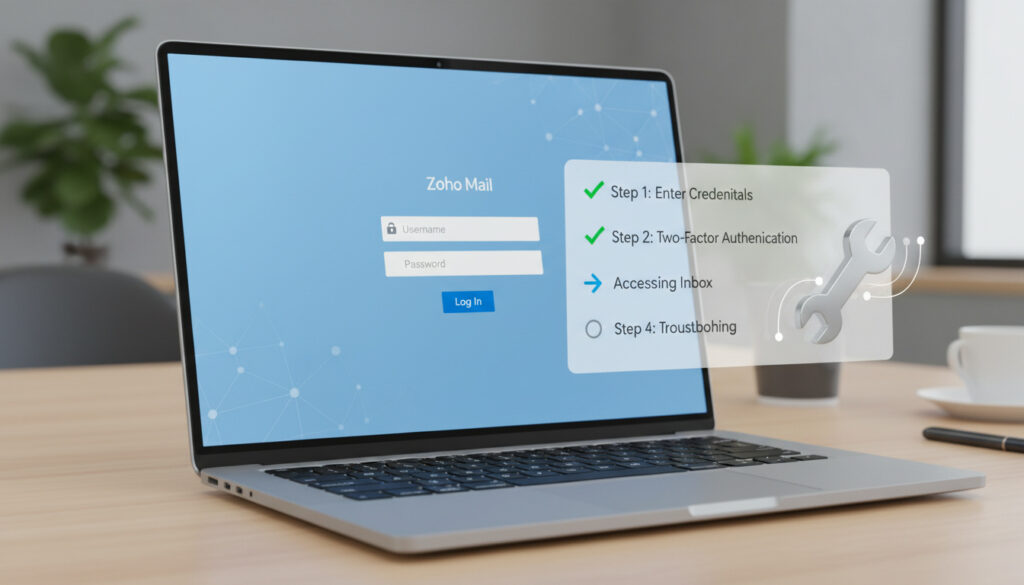
The Authentication Process Step-by-Step
- Navigate to mail.zoho.com
- Enter registered username and password
- Receive unique one-time password via SMS, voice, or QR when TFA enabled
- Input OTP to complete verification
- Access granted to inbox and mail functions
Established Procedures vs. Unanswered Questions
| Verified Capabilities | Uncertain or Undocumented Areas |
|---|---|
| TFA adds extra security layer requiring OTP for unrecognized devices | Specific Google SSO integration technical requirements |
| Administrators can reset TFA for users who lost device access | Standard password reset procedures without administrative access |
| Application-specific passwords required for POP/IMAP when TFA enabled | Browser compatibility specifications and requirements |
| OneAuth provides cloud backup and passphrase recovery | General troubleshooting for non-TFA login failures |
Why Zoho Mail Implements Strict Authentication
Business email platforms face persistent threats from unauthorized access attempts. Zoho Mail’s architecture reflects an emphasis on organizational security through layered verification protocols. The requirement for application-specific passwords in external clients prevents credential exposure across multiple platforms.
Administrative controls allow security teams to enforce consistent policies while providing recovery mechanisms for device loss scenarios. This balance between user autonomy and organizational oversight characterizes enterprise email management. The Day After Tomorrow – Plot Cast Ending and Science Facts explores how complex systems require backup protocols, similar to the recovery options available within Zoho’s infrastructure.
Official Documentation and Security Guidelines
Two-factor authentication adds an extra layer of security to your Zoho account. When TFA is enabled, anyone attempting to login from an unrecognized computer must provide additional authorization beyond their username and password.
— Zoho Community Documentation
This security architecture extends to mobile applications through the OneAuth system, which provides alternate verification modes including QR code scanning and offline OTP generation according to Zoho technical specifications.
Essential Access Procedures
Successful Zoho Mail authentication requires understanding the distinction between web browser entry, mobile application verification, and external client configuration. While standard username and password entry initiates all sessions, two-factor authentication introduces mandatory secondary steps for unrecognized devices. Administrators maintain critical reset capabilities for scenarios involving device loss, while individual users should configure OneAuth backup options to prevent access interruptions.
Frequently Asked Questions
Is Zoho Mail login secure?
Yes. The platform implements two-factor authentication requiring OTP verification via SMS, voice, or QR codes for unrecognized devices, alongside application-specific passwords for external client access.
How does two-factor authentication work?
After username and password entry, users receive a unique one-time password through SMS, voice call, or QR code. This secondary code must be entered to complete access from new or unrecognized devices.
What is Zoho Mail admin login?
Administrators access the Zoho Mail Admin Console to manage organizational security settings, including enabling TFA organization-wide and resetting two-factor authentication for users who lost device access.
Can I use Zoho Mail offline?
Mobile applications support offline OTP generation through OneAuth, allowing authentication without immediate network connectivity. Email content availability offline depends on client synchronization settings.
How do I recover access without my phone?
Individual users cannot self-reset TFA. An administrator must access the Admin Console, navigate to the specific user’s Security settings, and reset TFA to allow fresh setup during next sign-in.
Are application passwords permanent?
No. These 12-digit passwords are displayed only once during generation for security reasons. If lost or compromised, users must generate new application-specific passwords through their Zoho Accounts security settings.
More related posts
 SA Public Holidays – 2024, 2025 Dates and Rules
 Maghrib Time Sydney: Today’ Timetable & Key I lamic Rule
 Mason Cox: Biography, Height, and 2026 Move to Fremantle
 Ralph Lauren: Biography, Luxury Status, Health & Shopping Guide
 Baby Shower Games: 60+ Free Printables & Fun Ideas
 Ethan Slater: Ariana Grande Relationship, Ex-Wife, and Career
 Honey Joy Recipe: How to Make Classic Australian Honey Joys
 Optus Internet Outage: Check, Report & Get Updates