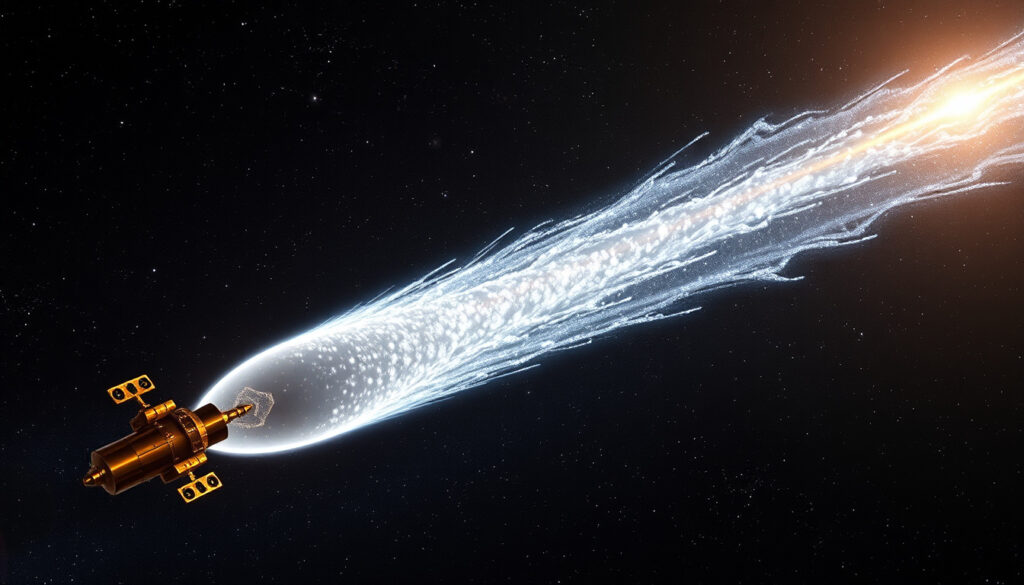
3i Atlas Latest News: Juice & JWST Insights on Fading Comet
A comet that traveled for millions of years through interstellar space just swung past our inner solar system—and it’s already beginning to fade from view. Ground telescopes tracked 3I/ATLAS through December 2025 before it approached the Sun, and now it’s racing back outward, soon to slip beyond the reach of even the sharpest instruments on Earth. What scientists managed to capture during its brief visit tells a remarkable story about the chemistry of distant worlds, and a few things that still puzzle them too.
Visibility Period: Through September 2025 ·
Key Observer: Juice spacecraft (ESA) ·
Recent Detection: Methane by JWST ·
Interstellar Origin: Confirmed ·
Next Observation: JWST spring 2026
Quick snapshot
- Third interstellar comet ever detected (NASA Science)
- Discovery on July 1, 2025 by ATLAS telescope in Chile (NASA Science)
- Closest approach to Earth: December 19, 2025 at 1.8 AU (NASA Science)
- Full composition details after perihelion passage
- Whether methane detections are widespread or localized
- Post-Sun passage long-term behavior
- Ground visibility: through September 2025
- Juice observations: November 2, 2025
- JWST next window: spring 2026
- 3I/ATLAS exits Solar System by early 2030s
- Additional JWST observations planned
- Science teams analyzing Juice and Hubble data
| Label | Value |
|---|---|
| Type | Interstellar Comet |
| Visibility End | September 2025 |
| Recent Observer | ESA Juice (November 2, 2025) |
| Composition Note | Methane detected |
| Earth Risk | None |
What is the 3I ATLAS doing now?
3I/ATLAS is currently fading as it moves away from the Sun, having reached perihelion on October 30, 2025 at 1.4 AU—roughly the distance of Mars from the Sun. The comet reached its closest point to Earth on December 19, 2025, passing at 1.8 AU (approximately 170 million miles), far beyond any risk of impact.
Current position and visibility
Ground-based telescopes could observe 3I/ATLAS through December 2025, and the comet reappeared in early December 2025 after its passage near the Sun. According to NASA Science, after passing through the inner solar system, the comet is now racing back outward toward the outer planets. It crossed beyond Jupiter’s orbit in March 2026 and will continue on a hyperbolic trajectory until it exits the Solar System entirely by the early 2030s.
Amateur astronomers with mid-sized telescopes had a narrow window to observe this visitor from another star system—September 2025 was the last chance before it headed too close to the Sun, and by early 2026, it’s already too far away for most ground instruments.
Fading trajectory details
The comet showed significant activity as it approached perihelion, releasing water vapor at a rate of 2,000 kg per second on November 2, 2025—equivalent to roughly 70 Olympic swimming pools worth of water each day. The Sky at Night Magazine reported that this water vapor primarily came from icy dust grains in the coma rather than directly from the nucleus itself. As it moves farther from the Sun, that activity is tapering off, and the comet is steadily dimming.
NASA’s TESS satellite observed 3I/ATLAS from January 15–22, 2026 to study its activity and rotation patterns, providing additional data on how the comet behaves as it cools down and heads back into deep space.
What has NASA said about the 3I ATLAS?
NASA has maintained a consistently calm tone about 3I/ATLAS since its discovery, treating the comet as a fascinating scientific target rather than any cause for alarm. The agency’s official pages document the comet’s discovery, trajectory, and what makes it scientifically interesting while emphasizing its safety for Earth.
NASA facts and FAQs
According to NASA Science, 3I/ATLAS became only the third confirmed interstellar comet ever detected, following 1I/’Oumuamua in 2017 and 2I/Borisov in 2019. The ATLAS telescope array in Chile first spotted it on July 1, 2025, though pre-discovery observations extend back to June 14, 2025 from both ATLAS and the Zwicky Transient Facility.
Comet 3I/ATLAS overview
The comet’s perihelion occurred on October 30, 2025 at a distance of 1.4 AU from the Sun. Its closest approach to Earth came on December 19, 2025 at 1.8 AU (170 million miles). NASA’s overview notes that the comet follows a hyperbolic trajectory at approximately 30 km/s, which will carry it out of the Solar System entirely by the early 2030s.
Scientists have had limited opportunities to study material from another star system up close. Each interstellar comet offers a sample of chemistry from an entirely different planetary system—a rare glimpse at what other stellar neighborhoods might contain.
Is the 3I ATLAS becoming a threat?
No. Despite the inevitable online speculation about this visitor from interstellar space, both NASA and ESA have confirmed there is no threat to Earth.
Impact risk evaluation
NASA confirmed on December 11, 2025, that 3I/ATLAS poses no danger to Earth. The comet’s closest approach to our planet was 1.8 AU—roughly 4.5 times the Earth-Moon distance—making any physical contact impossible. It is following a hyperbolic trajectory that takes it outward through the Solar System, not toward any planetary body.
NASA and ESA assessments
Both space agencies have consistently stated that 3I/ATLAS is safe. The ESA’s Juice mission, which observed the comet in November 2025, provided detailed measurements without any safety concerns. The Star Walk resource aggregates these confirmations, noting that the comet will not return to the inner Solar System after this passage.
What is so strange about the 3I ATLAS?
Interstellar comets are rare by definition—they originate from other star systems and happen to pass through ours. 3I/ATLAS has surprised scientists in several ways beyond simply being a visitor from another star.
Mysterious aspects
Scientists have documented several unusual features during 3I/ATLAS’s passage. A green glow around the comet was observed on September 20, 2025, likely caused by unusual gases in its coma. The Fox Weather outlet reported that the comet accelerated and turned visibly blue near the Sun in late October 2025. Keck Observatory spotted an anti-tail on October 19, 2025, a phenomenon where dust particles aligned along Earth’s line of sight create the appearance of a second tail pointing toward the Sun.
According to Space.com, recent observations show that the dust around 3I/ATLAS has slightly atypical properties, hinting that its grain sizes differ from those of local comets within our Solar System.
ESA frequently asked questions
ESA’s mission teams have addressed common questions about what Juice’s observations reveal. The spacecraft used five different instruments to study 3I/ATLAS on November 2, 12, and 19, 2025—its closest approach to the comet at just 41 million miles away. This data is now being analyzed to understand the comet’s composition and behavior in unprecedented detail.
What did recent spacecraft reveal about 3I/ATLAS?
Multiple spacecraft captured 3I/ATLAS during its visit, providing observations that ground-based telescopes simply cannot match. These data sets are still being analyzed and will keep scientists busy for years.
Juice mission findings
The ESA Juice (Jupiter Icy Moons Explorer) spacecraft captured some of the most detailed observations of 3I/ATLAS. On November 2, 2025, Juice’s NavCam recorded images showing the comet’s dust tail. The spacecraft’s Submillimeter Wave Instrument detected water vapor at 2,000 kg per second, though the Juice science team noted this amount was “not exceptional” compared to some comets at perihelion.
“The amount of water vapour leaving 3I/ATLAS is ‘not exceptional’, but is more than seen in some comets when they approach the Sun.”
— ESA Juice mission scientists, Sky at Night Magazine
The water vapor originated primarily from icy dust grains within the coma rather than directly from the comet’s nucleus—a detail detected specifically by Juice’s specialized instrument. High-resolution data from these November observations was received by February 2026 and is now undergoing detailed analysis.
JWST methane detection
The James Webb Space Telescope has been tasked with follow-up observations, though details of its specific findings are still emerging in scientific literature. The next major JWST observation window for 3I/ATLAS is planned for spring 2026, when the comet will be positioned for detailed spectroscopic analysis.
“Recent observations show this dust shows slightly atypical properties, hinting that its grain sizes differ from those of local comets.”
— NASA scientists, Space.com
The Hubble Space Telescope provided earlier context, first imaging 3I/ATLAS in November 2025 and revealing a teardrop-shaped dust cocoon. Hubble reobserved the comet on November 30, 2025, at 178 million miles from Earth, showing a bright core surrounded by dust glow.
NASA’s SPHEREx telescope observed what appears to have been a sudden release of water vapor, CO2, and organic molecules in February 2026, though these observations require further verification before publication in peer-reviewed literature.
3I/ATLAS traveled for potentially millions of years through interstellar vacuum, yet when it finally entered our Solar System, it began outgassing like a typical comet—and now that activity is already fading as it retreats. Scientists had one window to study this sample from another stellar neighborhood, and that window is closing fast.
Timeline of key events
| Date | Event |
|---|---|
| June 14, 2025 | Pre-discovery observations begin |
| July 1, 2025 | Discovery by ATLAS Chile |
| October 30, 2025 | Perihelion (closest to Sun) at 1.4 AU |
| November 2, 2025 | Juice primary observation |
| December 19, 2025 | Closest to Earth at 1.8 AU |
| January 15–22, 2026 | TESS rotation study |
| January 2026 | Crossed beyond Jupiter orbit |
What we know—and what we don’t
Here’s the current state of knowledge on 3I/ATLAS, drawn from verified observations and areas where scientists are still working to confirm details.
Confirmed facts
- Interstellar origin, confirmed by trajectory and hyperbolic orbit
- Third such object detected after ‘Oumuamua and Borisov
- No threat to Earth—confirmed by NASA on December 11, 2025
- Water vapor production detected by Juice on November 2, 2025
- Visible to ground telescopes through September 2025
What’s unclear
- Full composition profile after perihelion
- Whether methane detections are consistent across the coma
- Post-Sun passage long-term activity patterns
- Whether SPHEREx December 2025 outburst data will be confirmed
Related reading: 3i Atlas Latest News: Juice Views Water Jets in Interstellar Comet
Recent Juice and JWST observations of the fading comet expand on Third Interstellar Comet Insights shared across scientific communities worldwide.
Frequently asked questions
Is 3I/ATLAS speeding up?
Yes, 3I/ATLAS accelerated as it approached the Sun, a behavior typical of comets as solar heating releases frozen gases that act like natural thrusters. It reached approximately 30 km/s and will maintain this hyperbolic speed as it exits the Solar System.
What would happen if 3I/ATLAS hit Earth?
Nothing—because it won’t. The comet’s closest approach to Earth was 1.8 AU (170 million miles) on December 19, 2025. NASA has confirmed it poses no danger and is on a trajectory that takes it outward, not toward any planet.
Is 3I ATLAS an alien?
No. 3I/ATLAS is a comet of natural origin—it just happens to have originated from another star system rather than forming within our own. Its trajectory, composition, and behavior all match natural cometary characteristics observed in our Solar System, just from a different stellar neighborhood.
Where is 3I/ATLAS now?
As of early 2026, 3I/ATLAS has crossed beyond Jupiter’s orbit and is heading outward through the Solar System. It will continue on its hyperbolic trajectory until it exits the Solar System entirely by the early 2030s. For observers on Earth, the comet is no longer visible to most ground-based instruments.
When will 3I/ATLAS pass Earth?
3I/ATLAS reached its closest point to Earth on December 19, 2025, at a distance of 1.8 AU (approximately 170 million miles). This was its closest approach during this visit and it will not return—it is on an escape trajectory that will carry it out of the Solar System.
What are the latest images of 3I/ATLAS?
The most recent spacecraft images come from Hubble’s November 30, 2025 observation, showing a bright core with surrounding dust glow, and Juice’s NavCam images from November 2, 2025, capturing the comet’s dust tail from 41 million miles away. Ground-based images through September 2025 captured the comet before it passed too close to the Sun.
Is Comet 3I/ATLAS visible now?
For most observers, no. Ground-based telescopes could view the comet through September 2025, and it reappeared briefly in early December 2025 after its perihelion passage. However, as of early 2026, the comet has moved too far from the Sun and too far from Earth for amateur telescopes. JWST and other professional facilities will continue tracking it.
For planetary scientists, the implications of 3I/ATLAS are still unfolding. The ESA Juice mission data, Hubble images, and upcoming JWST observations will keep research teams busy analyzing what this interstellar visitor can teach us about chemistry across the galaxy. What they learn will shape how scientists understand the building blocks of planets and comets in stellar systems far beyond our own.
More related posts
 Companion (2025 Film): Plot, Cast, Reviews & Queer?
 Hang Son Doong Tour: Cost, Size & How to Visit
 Marsden Park Weather: BOM Forecast, Hourly & Radar
 Jimmy Fallon: Biography, Family, Net Worth, Controversies
 Jessica Chastain: Children, Ethnicity, Weight Loss Facts
 Brisbane Heat vs Adelaide Strikers: Match Scorecard & Records
 Chrissy Teigen: Health, Family, and Sobriety Milestones
 Sean Darcy: Biography, Injury, Contract, and AFL Career