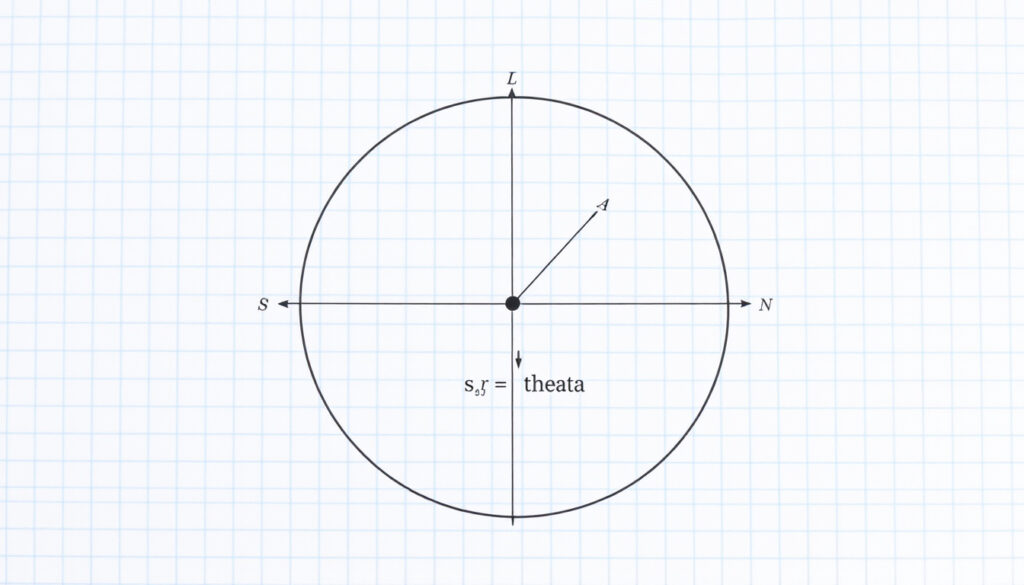
Arc Length Formula – Complete Guide With Examples
The arc length formula quantifies the distance along a curved path between two points. This fundamental concept bridges simple geometry and advanced calculus, appearing in applications ranging from engineering to computer graphics. Understanding how to calculate arc length unlocks practical tools for measuring curved components, designing transport routes, and modeling natural phenomena.
Arc length calculations differ substantially depending on whether the curve is a perfect circle or a more complex function. The circle offers a straightforward relationship between radius, angle, and distance traveled along its circumference. Calculus extends this principle to arbitrary curves through integration, approximating the curved path with increasingly small straight segments.
Arc Length Formula: Complete Guide with Examples
What Is the Arc Length Formula?
The arc length formula measures the distance along a curve between two points. For a function y = f(x) with a continuous derivative on the interval [a, b], the arc length L is given by the integral L = ∫ from a to b of √(1 + [f'(x)]²) dx. This formula arises from approximating the curve with small line segments and refining the approximation without bound.
The derivation begins with the differential arc length element ds = √(dx² + dy²) = √(1 + [dy/dx]²) dx. Summing these infinitesimal elements across the interval produces the integral formula. For parametric curves where x(t) and y(t) are functions of a parameter t, the formula generalizes to L = ∫ from t₁ to t₂ √([dx/dt]² + [dy/dt]²) dt. Understanding the relationship between parametric equations and arc length opens doors to analyzing complex trajectories in multiple dimensions.
The formula requires a continuous derivative (smooth curve). Curves with sharp corners or cusps require splitting the integral at points where the derivative fails to exist.
L = rθ (θ in radians)
L = (θ/360) × 2πr
∫ √(1 + [f'(x)]²) dx
Physics, engineering, navigation
Key Insights About Arc Length
- The circle formula L = rθ requires the angle θ measured in radians, not degrees
- Integration approximates polygonal paths along the curve with unlimited refinement
- Exact analytical solutions exist only for specific curves like circles, parabolas in limited intervals, and ellipses in special cases
- Most practical arc length calculations require numerical approximation methods
- The formula generalizes to three-dimensional parameterizations for curves in space
- Arc length differs fundamentally from chord length, which measures the straight-line distance between endpoints
| Parameter | Formula | Notes |
|---|---|---|
| Circle (radians) | L = rθ | θ must be in radians |
| Circle (degrees) | L = (θ/360) × 2πr | θ in degrees |
| Calculus (Cartesian) | ∫ √(1 + [f'(x)]²) dx | Requires continuous derivative |
| Parametric curve | ∫ √([dx/dt]² + [dy/dt]²) dt | t from t₁ to t₂ |
| Polar coordinates | ∫ √(r² + [dr/dθ]²) dθ | r as function of θ |
| 3D space curve | ∫ √([dx/dt]² + [dy/dt]² + [dz/dt]²) dt | Space curve applications |
Arc Length Formula for a Circle
For a circle, arc length depends directly on the radius and the central angle subtended by the arc. The fundamental relationship states that arc length equals the radius multiplied by the angle in radians. This elegant simplicity makes circular arc calculations straightforward in practical applications.
Understanding the Circle Formula
The formula L = rθ emerges from the definition of radian measure. One radian corresponds to an angle where the arc length equals the radius. A complete circle spans 2π radians, yielding a circumference of 2πr. The quarter circle represents π/2 radians, while a half circle spans π radians.
When working with degrees, the equivalent formula L = (θ/360) × 2πr converts the angle to a fraction of the full 360°. This conversion frequently appears in practical measurements, as degree notation remains more familiar than radian measure in everyday contexts.
For a quarter circle with radius 6 cm and angle 90°: L = (90/360) × 2π × 6 = 3π cm ≈ 9.42 cm. Converting to radians (90° = π/2), the same result follows from L = 6 × (π/2) = 3π cm.
Semicircle Arc Length
A semicircle arc extends through π radians, representing exactly half the circumference. For a semicircle of radius r, the arc length equals πr. The semicircle case serves as a useful reference point for verifying calculations and understanding angle-to-length relationships.
Calculus verification confirms this result. For the upper semicircle f(x) = √(r² – x²) from x = -r to x = r, the derivative f'(x) = -x/√(r² – x²). Computing 1 + [f'(x)]² = 1/(r² – x²) leads to the integral yielding πr as expected. This example demonstrates how integration techniques from calculus can verify geometric results.
Arc Length Formula in Calculus
Calculus extends arc length calculations beyond perfect circles to any smooth curve. The integral formula L = ∫ from a to b √(1 + [f'(x)]²) dx applies to Cartesian curves where the function possesses a continuous derivative across the interval.
Step-by-Step Integration Method
The integration process follows four essential steps. First, compute the derivative f'(x) of the given function. Second, square this derivative and add 1 to obtain 1 + [f'(x)]². Third, take the square root to form the integrand √(1 + [f'(x)]²). Finally, evaluate the definite integral across the specified bounds.
This procedure requires the derivative to remain continuous throughout the interval. Curves containing cusps, corners, or vertical tangents must be partitioned at these points, with separate integrals computed for each smooth segment.
Mixing degree and radian measure represents the most frequent source of error in arc length calculations. Always verify that angular measurements match the formula requirements before computing.
Parameterization and Generalization
For parametric curves defined by x(t) and y(t), the arc length formula becomes L = ∫ from t₁ to t₂ √([dx/dt]² + [dy/dt]²) dt. This formulation proves essential for curves that cannot be expressed as single-valued functions of x or y.
In polar coordinates where r depends on θ, the formula transforms to L = ∫ √(r² + [dr/dθ]²) dθ. This variation handles curves like spirals and cardioids that present naturally in polar form. The conversion between polar and Cartesian coordinates enables analysis of curves in whichever coordinate system proves more convenient.
Three-dimensional curves in space require adding the z-component: L = ∫ √([dx/dt]² + [dy/dt]² + [dz/dt]²) dt. This generalization proves vital in physics for calculating the path length of particles and in engineering for analyzing cable and wire configurations.
Arc Length Examples for Parabolas and Ellipses
Parabolas and ellipses represent important curve families where arc length calculations become substantially more complex than for circles. While circle arc lengths yield exact algebraic expressions, most parabola and ellipse calculations require either special integration techniques or numerical approximation.
Parabola Arc Length
For the parabola y = x² from x = 0 to x = 1, the derivative equals 2x. Substituting into the integral formula produces L = ∫ from 0 to 1 √(1 + 4x²) dx. This integral yields to trigonometric substitution, with the exact result involving logarithmic and hyperbolic functions.
Numerical evaluation of ∫₀¹ √(1 + 4x²) dx produces approximately 1.478. This value represents the distance along the parabola between the origin and the point (1, 1). More complex parabolas may require numerical integration methods for practical answers.
Ellipse Arc Length
Ellipse arc length presents particular mathematical challenges. The perimeter of a general ellipse lacks a closed-form expression in elementary functions. For the ellipse x = a cos(t), y = b sin(t) with a > b, the arc length integral becomes L = ∫₀²π √(a² sin²t + b² cos²t) dt.
This integral expresses through the elliptic integral of the second kind E(e) = ∫₀^(π/2) √(1 – e² sin²φ) dφ, where the eccentricity e = √(1 – [b/a]²). The complete ellipse perimeter equals 4aE(e). Only special cases with specific eccentricity values yield simplified expressions.
When a = b (the ellipse becomes a circle), eccentricity e = 0 and E(0) = π/2, recovering the familiar circumference 2πa. This limiting behavior confirms the consistency between circular and elliptical formulas.
Arc Length vs. Chord Length
The distinction between arc length and chord length fundamental to understanding curved geometry. Arc length measures the actual distance traveled along the curve, while chord length measures the straight-line distance directly connecting the endpoints.
Understanding the Difference
For any curved segment, arc length exceeds chord length except in the limiting case of zero curvature where both measures converge. The difference between these quantities relates directly to the curvature of the path. Higher curvature produces larger discrepancies between the curved path and its straight-line approximation.
The chord length formula for circle endpoints at angles θ₁ and θ₂ states: chord = 2r sin(|θ₂ – θ₁|/2). For small angles, the difference between arc and chord approximates rθ³/24, demonstrating that the gap grows cubically with angular extent.
Comparative Examples
| Curve | Arc Length | Chord Length | Difference |
|---|---|---|---|
| Quarter circle (r=1) | π/2 ≈ 1.571 | √2 ≈ 1.414 | 0.157 |
| Parabola y=x², [0,1] | ∫√(1+4x²)dx ≈ 1.478 | √2 ≈ 1.414 | 0.064 |
These examples illustrate how the arc-chord difference varies with curve type and extent. The quarter circle shows a larger relative difference than the parabola segment, reflecting the circle’s constant curvature versus the parabola’s varying curvature.
Historical Development of Arc Length Calculations
Arc length concepts trace back to ancient mathematics, where scholars sought methods for measuring curved paths. Archimedes developed approximations for curved lengths using polygonal inscribed and circumscribed paths, establishing foundational ideas that calculus would later formalize.
- Ancient Period — Greek mathematicians including Archimedes approximated curved lengths using inscribed polygon perimeters, bounding the true value between upper and lower estimates.
- 17th Century — Development of calculus by Newton and Leibniz provided systematic integration methods, formalizing the arc length integral for arbitrary smooth curves.
- 18th-19th Century — Elliptic integrals emerged as the standard tool for ellipse and related curve calculations, establishing connections to number theory and complex analysis.
- Modern Era — Numerical approximation methods and computer algorithms enable practical arc length calculations for any smooth curve, even without closed-form solutions.
Established Facts vs. Unresolved Questions
| Established Information | Approximate or Unresolved |
|---|---|
| Circle arc length formula yields exact results for any angle | General ellipse perimeter requires elliptic integrals with no elementary closed form |
| Calculus integral formula applies universally to smooth curves | Many specific curve integrals lack analytical solutions and require numerical approximation |
| Chord length formula for circles is exact | Arc-chord difference formulas for complex curves require case-by-case analysis |
| Parameterization extends formula to 3D curves | Optimal numerical integration strategies depend on curve properties |
Applications and Context
Arc length calculations underpin numerous practical applications across science and engineering. GPS navigation systems compute travel distances along curved Earth surfaces rather than straight lines through the planet. Computer graphics and animation rely on arc length concepts for smooth motion along curved paths.
Mechanical engineering applies arc length principles when designing gears, cam profiles, and conveyor systems. Architects calculate curved structural elements to determine material requirements and stress distributions. Surveying and cartography employ arc length formulas for accurate distance measurements across curved surfaces.
Common errors in arc length calculations stem from unit inconsistency, particularly mixing degrees and radians in the circle formula. The requirement for continuous derivatives often surprises beginners accustomed to working with piecewise functions. Remembering that arc length represents a physical distance ensures appropriate units in final answers.
“The arc length of a curve is fundamentally a path integral, measuring distance along the curve rather than through it.”
— Stewart Calculus, Early Transcendentals
Summary
The arc length formula extends from the simple circle relationship L = rθ to the general calculus integral L = ∫ √(1 + [f'(x)]²) dx for smooth curves. Circle calculations yield exact results, while parabola and ellipse arc lengths typically require numerical approximation or elliptic integrals. Understanding the distinction between arc length and chord length clarifies why curved paths always exceed straight-line distances between the same endpoints. Practical applications span navigation, engineering, computer graphics, and architecture, making this fundamental concept essential across multiple disciplines.
For related mathematical concepts, explore Huda Love Island – Age, Job, Background and Season 7 or learn more about Pixel Watch 4 – Release Date Price Specs Features.
Frequently Asked Questions
What units does arc length use?
Arc length uses length units consistent with the radius or coordinate system. If radius is measured in meters, the resulting arc length also appears in meters. The formula itself produces dimensionless results when all measurements share the same units.
Can arc length be negative?
Arc length is always nonnegative, representing a physical distance. The integral of a speed function produces nonnegative values when proper absolute values are applied. Negative values might appear only in intermediate calculations involving signed distances.
How do you find arc length for polar curves?
For polar curves where r depends on θ, the formula becomes L = ∫ √(r² + [dr/dθ]²) dθ over the appropriate angle range. This follows from converting polar to Cartesian derivatives and applying the parametric arc length formula.
What is the arc length of a semicircle?
A semicircle with radius r has arc length πr. This represents exactly half the circumference of a complete circle with the same radius. The result follows from the general circle formula with θ = π radians.
Why does the arc length formula require radians?
The radian requirement emerges from how angle measure relates to arc length in a circle. Radians directly represent the ratio of arc length to radius, making L = rθ work without additional conversion factors. Degrees would require the factor (π/180) to account for the different scaling.
What curves have exact arc length formulas?
Circles, catenaries, logarithmic curves, and certain cycloids admit exact arc length expressions in elementary functions. However, most curves—including general ellipses and higher-degree polynomials over extended intervals—require elliptic integrals or numerical methods.
How is arc length used in physics?
Physics employs arc length in particle trajectory calculations, work done along curved paths, and electromagnetic field line analysis. The action in Lagrangian mechanics integrates Lagrangian values along particle paths, with arc length providing the spatial measure for these calculations.
More related posts
 Colin Fassnidge: Cocaine Driving Case & Career Update
 Wentworth Miller: Autism Diagnosis and Career Timeline
 Lydia Ko: Age, Husband, Net Worth, Major Wins, and More
 Elon Musk: Biography, Net Worth, Health, Religion, Key Facts
 Izak Rankine: AFL Career, Background, Height, and Speed
 Origin Game 3 – 2026 Date Tickets Suncorp Guide
 Dune Part 2 – Release Date, Cast, Plot and Streaming Guide
 Vaibhav Suryavanshi Age Controversy: Biography, Family, IPL Career