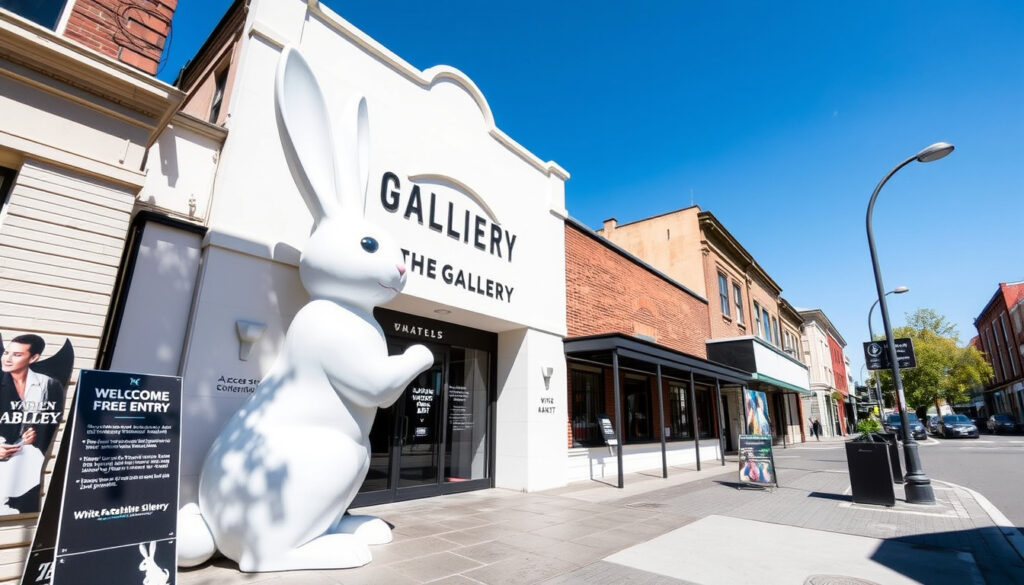
White Rabbit Gallery Sydney: Free Entry, Hours & How to Visit
Sydney’s Chippendale neighbourhood hides one of the city’s most quietly impressive cultural assets — a gallery that throws open its doors for free, fills four floors with contemporary Chinese art, and serves dumplings on the ground floor. The White Rabbit Gallery has been turning heads since 2009, and if you’ve never made the short walk from Central Station, you’re missing something that regularly lands on “best things to do in Sydney” lists.
White Rabbit Gallery is a state-of-the-art temple to contemporary Chinese art.
— Time Out Sydney
Location: Chippendale, Sydney, NSW · Founded: 2009 · Entry Fee: Free · Opening Hours: Wed-Sun 10am-5pm · Collection Size: 3000+ works by 800+ artists
Quick snapshot
- Entry is free — no tickets required (White Rabbit Gallery Official)
- Open Wednesday to Sunday 10AM-5PM (White Rabbit Gallery Official)
- Guided tours run at 11AM and 3PM daily (White Rabbit Gallery Official)
- Exact dates for current or upcoming exhibitions
- Confirmation of any changes since sources were last updated
- Whether online booking will be introduced in future
- Founded after Judith Neilson’s Beijing trips in the late 1990s (NSW Government)
- Gallery opened to public in 2009 (White Rabbit Gallery Official)
- Closures for installation typically hit February and August (NSW Government)
- Exhibitions change twice a year — plan around closure dates
- New installations likely to arrive late 2026 or early 2027
- Tea house remains a drawcard for post-gallery dumplings
The table below consolidates the essential details visitors need to plan their trip.
| Detail | Information |
|---|---|
| Address | 30 Balfour Street, Chippendale NSW 2008, Australia |
| Opened | 2009 |
| Entry | Free |
| Hours | Wednesday-Sunday 10am-5pm |
| Tours | 11am and 3pm (no booking required) |
| Features | Tea house on ground floor |
How much does it cost to go to the White Rabbit Gallery?
The short answer is refreshingly simple: nothing. Admission is completely free, and there are no hidden fees, no required donations, and no ticketed exhibitions to pick between. The gallery’s own FAQ states it plainly — you can walk in off the street during opening hours without spending a cent. This policy isn’t a temporary promotion or a first-visit deal; free entry has been the model’s norm since the gallery opened in 2009. That makes it a rare creature in Sydney’s arts scene, where even modest galleries often charge $15-20 per adult. The gallery operates as a registered charitable institution funded solely by founder Judith Neilson, which means the collection is self-sustaining through private philanthropy rather than ticket revenue. For visitors watching their budget, this alone makes White Rabbit worth marking on any Sydney itinerary. Even the tea house and gift shop are optional add-ons rather than compulsory parts of the experience.
Sydney’s arts scene can eat into a travel budget quickly, but White Rabbit Gallery sidesteps that entirely. Walking in free means you can spend what you save on the tea house’s dumplings instead — roughly $15-20 for a generous serve.
Entry fees and tickets
No tickets are required at any time of year. You don’t need to book in advance, there’s no timed-entry system, and there are no special events that demand a paid upgrade. The official visit page confirms that free entry applies across all exhibitions and all four floors of the building. This makes spontaneous visits straightforward — you can show up on a Wednesday afternoon without planning ahead. Group visits are not accommodated due to the building’s size and layout, but individual visitors and small clusters are welcome without any pre-notification.
Free access details
The only scenario where costs might enter the picture is parking. If you’re driving, nearby options include metered street parking (limited to 2 hours), the Broadway Shopping Centre (free for the first 2 hours, about a 10-minute walk away), and the Four Points by Sheraton Sydney Central Park car park, which offers a $25 flat rate for White Rabbit visitors who scan a QR code at reception. Beyond that, the tea house and gift shop represent optional spending — not gatekeeping charges.
Free admission reflects Judith Neilson’s deliberate choice to fund the gallery entirely from private wealth rather than ticket sales. That decision shapes every aspect of the visitor experience — there is no tiered pricing, no membership wall, and no pressure to spend once inside.
Bottom line: White Rabbit Gallery removes cost as a barrier entirely. Budget-conscious visitors can explore four floors of contemporary Chinese art at zero charge and allocate their savings toward dumplings at the tea house instead.
Why is it called White Rabbit Gallery?
The name traces back to Judith Neilson’s original inspiration. After visiting Beijing in the late 1990s, the Australian philanthropist and collector was so struck by the energy of contemporary Chinese art that she began assembling what would become one of the world’s most significant collections of the form. The “white rabbit” itself has roots in Chinese cultural symbolism — often associated with the Moon Festival legend — but in the context of the gallery, it functions more as an elegant marker of Eastern cultural exchange meeting Western philanthropy. The collection was initially housed in a warehouse space before the current site opened in 2009, and the name stuck through the transition. Today, the gallery’s homepage describes it as housing one of the world’s most significant collections of Chinese contemporary art, making the name a brand as much as a label.
Architect William Smart designed the building’s interior, converting a 1940s Rolls-Royce service depot into the four-floor contemporary art space that now draws visitors from across Sydney and beyond. The tea house on the ground floor carries the rabbit motif forward — literally, in the gift shop’s rabbit-themed items — creating a cohesive visitor experience that ties the name back to the surroundings at every turn.
The White Rabbit Gallery was opened in 2009 to showcase what has become one of the world’s most significant collections of Chinese contemporary art.
— White Rabbit Gallery Official
The name anchors the gallery’s identity without overwhelming it — visitors familiar with the Moon Festival legend may pick up additional layers of meaning, but the branding works equally well as a simple, memorable identifier.
How do you get to the White Rabbit Gallery?
The gallery sits at 30 Balfour Street in Chippendale, and getting there on public transport is straightforward. Both Central Station and Redfern Station are roughly a 10-minute walk away, with Railway Square’s bus terminal also nearby. From Central, you head south down George Street, turn onto Balfour Street near the University of Technology Sydney campus, and walk the remaining block. Redfern visitors approach from the east via Redfern Street and Regent Street. The walk is flat, footpath-based, and well-signposted once you’re in the Chippendale grid. If you’re relying on the light rail, the new tram line through Ultimo and Pyrmont puts you within a similar distance — check current routes, as the network has expanded since previous iterations of this guide.
Chippendale is increasingly dense with things to do — bars, restaurants, markets — and White Rabbit Gallery sits at the edge of that activity, making it a natural mid-afternoon stop if you’re exploring the neighbourhood.
Public transport options
Train is the most reliable option. Both Central and Redfern stations sit on major lines (T1/T4 and T3/T4 respectively), and the walk from either is clearly signposted. Buses serving the Railway Square stop on George Street also put you within a short radius. Once in Chippendale itself, the short block to Balfour Street requires no further transit — it’s genuinely walkable from any of the nearby hubs.
Driving and parking
Driving isn’t the most convenient choice for this area — the gallery has no dedicated parking — but options exist if you’re arriving by car. On-street metered parking is available nearby with a 2-hour limit, which works for a quick visit. Broadway Shopping Centre, about 10 minutes away on foot, offers the first 2 hours free, making it the best bet for longer visits. The Four Points by Sheraton Sydney Central Park car park offers a $25 flat rate for gallery visitors who scan the QR code at reception — enter after 9am, exit before 6pm Wednesday through Friday and Sunday. Disabled parking spots are located at 71 Regent Street and Myrtle Street in Chippendale, per the gallery’s official FAQ.
Walking from nearby areas
Chippendale’s streets are relatively flat and pedestrian-friendly. The gallery’s position near the border of the suburb means it’s accessible from Ultimo (to the south), Redfern (to the east), and Central itself (to the north). If you’re combining a visit with the University of Technology Sydney campus, the White Rabbit makes a logical nearby detour. The converted Rolls-Royce depot is distinctive once you spot the signage — look for the white rabbit motif on Balfour Street.
Getting to White Rabbit Gallery by public transport costs nothing beyond the fare and takes roughly 10 minutes from Central or Redfern. Driving adds parking complexity and expense without any time advantage in this walkable precinct. For those interested in the broader context of tragic events, the Mosman Park deaths Clune family incident offers a somber parallel. Mosman Park deaths Clune family
Bottom line: Take the train to Central or Redfern and walk 10 minutes south. Driving and parking add cost and complexity for no time saving in this compact neighbourhood.
How long do you need at White Rabbit Gallery?
Most visitors spend between one and two hours at the gallery, according to visitor reviews on TripAdvisor. The exact time depends on how deeply you engage with each floor — the collection spans over 3,000 works by more than 800 artists, so lingering in front of individual pieces is entirely possible. A typical route involves starting at the ground floor (tea house entrance, reception, gift shop), working upward through floors one to three, and exiting through the gift shop on the way out. That sequence can be knocked out in 60 minutes if you’re moving at pace, or stretched to 90 minutes if you’re reading labels and pausing for photos.
Recommended visit duration
One hour is a workable minimum — enough to cover all four floors and absorb the broad strokes of whatever exhibition is currently installed. If you’re a serious art enthusiast or want to spend real time in the tea house, budget 90 minutes to two hours. The exhibitions rotate twice a year, so repeat visitors often find something new to engage with even on return trips.
Floor-by-floor guide
The ground floor holds the tea house (serving teas and dumplings) and reception. Exhibitions begin formally from the first floor upward, with each level offering a distinct curatorial theme tied to the current exhibition cycle. The gallery’s visit page notes that the exhibitions are rotated twice a year, typically with closure periods in February and August for installation. That means every six months, the experience effectively resets. For first-time visitors, the building itself — a converted 1940s Rolls-Royce service depot refitted by architect William Smart — is worth noting as a piece of Sydney’s adaptive reuse history. The gift shop at the exit stocks colourful, gallery-branded items and makes for a natural last stop.
The exhibitions change completely twice a year, which means a 60-minute visit captures only one curatorial moment in a continuously evolving programme. Returning every six months rewards visitors with an entirely fresh experience across all four floors.
Who funds White Rabbit Gallery?
The gallery is funded entirely by Judith Neilson, an Australian philanthropist who founded the collection after trips to Beijing in the late 1990s. She established the space as a registered charitable institution, meaning it operates without government funding, corporate sponsorship, or ticket revenue. The model is unusual in Sydney’s arts landscape: a private collector choosing to build and maintain a world-class cultural institution at personal cost, then open it to the public for free. According to Sydney.com, the collection has grown to include over 3,000 works by more than 800 artists, all focused on 21st-century Chinese contemporary art. Neilson’s commitment to the collection is ongoing — acquisitions continue, exhibitions are refreshed twice yearly, and the tea house operates as a hospitality complement rather than a profit centre. The charitable structure means donations are tax-deductible in Australia, which occasionally attracts additional support, but the gallery’s primary funding remains Neilson’s personal commitment.
A privately funded model means the gallery’s future depends on a single patron’s sustained commitment. If that changes, the institution’s survival isn’t guaranteed — something worth noting if you’re planning a once-in-a-city visit.
Owner and funding sources
Judith Neilson is both the founder and sole funder. She is not involved in day-to-day gallery operations — a professional team runs programming, installations, and visitor services — but her vision shapes the collection’s direction and scope. The gallery has not sought commercial partnerships or naming rights, which keeps the visitor experience free of corporate branding. This independence is part of what makes the gallery distinctive, though it also explains why the institution has no buffer if funding circumstances shift. The tea house operates as a small revenue line that supplements operations, but it is not the gallery’s financial backbone.
Judith Neilson’s continued funding ensures free entry persists, but a single-source model carries inherent vulnerability. Visitors who want this gallery to survive should appreciate that their experience depends entirely on one patron’s sustained generosity.
Related reading: Sydney Opera House: History, Facts, Tours & Visitor Guide · Queen Victoria Building – Sydney Heritage Shopping Guide
Similar to White Rabbit’s vast contemporary Chinese collection, Kelvingrove Art Gallery houses thousands of artworks across themed galleries with free entry.
Frequently asked questions
What are the opening hours of White Rabbit Gallery?
The gallery is open Wednesday to Sunday from 10am to 5pm. It is closed on Mondays and Tuesdays. Closures for exhibition installation typically occur in February and August, so it’s worth checking the official visit page before planning a trip during those months.
Where is White Rabbit Gallery located?
The gallery is at 30 Balfour Street, Chippendale NSW 2008, Australia. It’s a 10-minute walk from Central Station and Redfern Station. Nearby parking is available at Broadway Shopping Centre (first 2 hours free) or the Four Points by Sheraton car park ($25 flat rate with QR code).
What type of art is shown at White Rabbit Gallery?
The gallery focuses entirely on contemporary Chinese art, featuring works by artists working in and around China in the 21st century. The collection spans painting, sculpture, video, installation, and new media. Exhibitions rotate twice a year, meaning each visit typically presents a different curatorial focus.
Are there guided tours at White Rabbit Gallery?
Yes. Free guided tours run at 11am and 3pm Wednesday to Sunday. No booking is required — you simply turn up. The tours are led by gallery staff and cover the current exhibition across all floors. Small groups are welcomed; the gallery notes that group visits are not otherwise accommodated due to building limitations.
Does White Rabbit Gallery have a cafe or tea house?
There is a tea house on the ground floor serving teas and dumplings. It is not a full restaurant, but it offers a genuine hospitality experience that complements the art — something many visitors cite as a highlight. The gift shop is also located near the exit.
What is the White Rabbit Collection?
The White Rabbit Collection is the body of work housed in the gallery. It holds over 3,000 works by more than 800 artists, all focused on 21st-century Chinese contemporary art. The collection is the basis for the gallery’s rotating exhibitions and represents one of the largest private holdings of its kind outside mainland China.
How often do exhibitions change at White Rabbit Gallery?
Exhibitions change twice a year, roughly every six months. The gallery typically closes for installation in February and August, with the new exhibitions opening shortly after. Each exhibition cycle runs approximately five months. Visiting twice a year — once in autumn/winter and once in spring/summer — would give you a nearly complete annual picture of the programming.
For visitors who’ve already ticked the obvious Sydney landmarks off their list, White Rabbit Gallery fills a gap that’s easy to overlook. The free entry and central Chippendale location remove most of the friction that keeps people from discovering it, and the tea house makes it the kind of stop you can linger in rather than rush through. Whether you’re a dedicated contemporary art follower or simply curious about what Sydney’s cultural scene offers beyond the Opera House and Art Gallery of New South Wales, a Wednesday afternoon at 30 Balfour Street is worth carving out of any itinerary.
More related posts
 Vegas Matt: Real Name, Net Worth, and Latest Updates 2024
 New COVID Variant Australia – Latest JN.1 and Vaccine Facts
 How to Deactivate Facebook (iPhone, Android, De ktop)
 Allison Williams: Biography, Husband, Movies, and FAQs
 Judi Dench: Health, Family, Career & Relationship Updates
 Peanut Butter Cookies: 3-Ingredient, Air Fryer, Keto
 Companion (2025 Film): Plot, Cast, Reviews & Queer?