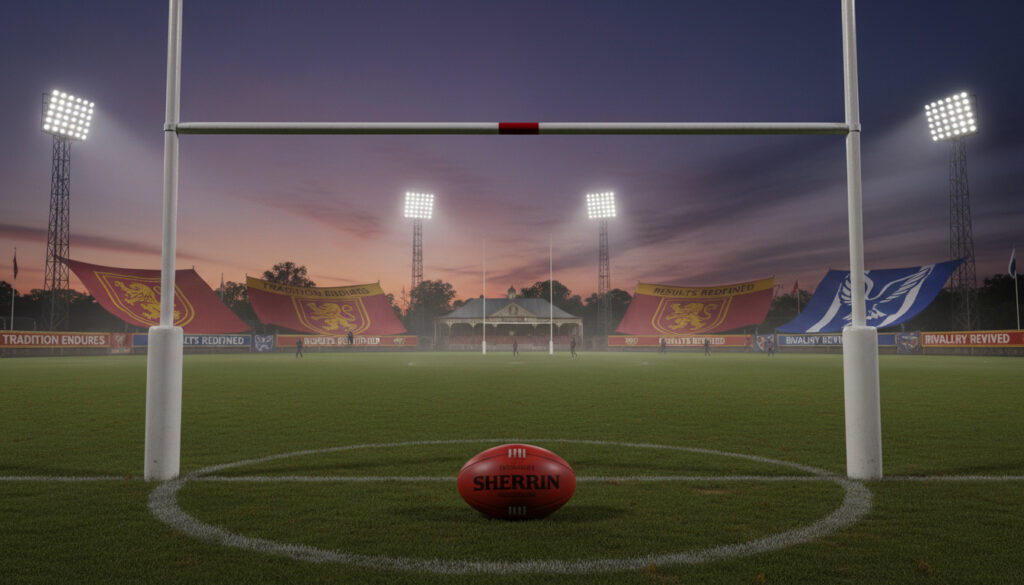
AFL State of Origin – History, Results and Revival
AFL State of Origin represents the pinnacle of interstate Australian rules football, pitting state against state with elite players representing their birthplace rather than professional club allegiances. The competition formalized in 1977 after nearly a century of informal interstate matches, creating intense rivalries that captivated national audiences until its controversial demise in 1999.
Unlike the National Rugby League’s ongoing State of Origin series, the AFL version emerged from a specific historical context where non-Victorian states sought to counter the dominance of the Victorian Football League’s recruiting power. The format demanded that players represent the state where they learned the game, fundamentally altering the competitive balance that had previously favored Victoria in all representative contests.
The series produced unforgettable encounters between powerhouse football states, particularly Victoria, Western Australia, and South Australia, before succumbing to the pressures of a fully nationalized professional league where club commitments ultimately superseded state loyalties.
What is AFL State of Origin?
AFL State of Origin constituted a representative football format where players competed for their state of origin—the geographical region where they developed their skills during junior football—rather than the professional club that held their playing contract. This selection methodology fundamentally distinguished the competition from earlier interstate matches that often resulted in lopsided Victorian victories due to VFL clubs recruiting talent nationwide.
1977
1999
Victoria
State of Origin
Key Characteristics of the Competition
- Selection Criteria: Players qualified based on where they grew up and learned Australian rules football, not their current club residence, ensuring Western Australia and South Australia could field genuinely competitive sides against Victoria.
- Peak Popularity: The series reached its zenith during the 1980s, with matches regularly drawing capacity crowds and television audiences exceeding one million viewers nationally.
- Elite Participation: Every major star of the era participated, including representatives from all VFL clubs, treating the matches with premiership-level intensity.
- Geographic Expansion: While Victoria, Western Australia, and South Australia formed the core rivalry, Tasmania, New South Wales, Queensland, the ACT, and the Northern Territory also fielded teams during carnival years.
- Competitive Balance: The 1977 inaugural match resulted in a 94-point Western Australian victory over Victoria, immediately establishing that the new format produced genuinely competitive contests.
- Rule Consistency: Matches operated under standard Australian rules, though states occasionally adopted tactical innovations that later filtered into the national competition.
Notable Matches and Results
| Year | Matchup | Result | Venue | Significance |
|---|---|---|---|---|
| 1879 | Victoria vs South Australia | Victoria 56 defeated SA 3 | MCG | First interstate match |
| 1977 | WA vs Victoria | WA 23.13 (151) d Vic 8.9 (57) | Subiaco Oval | Inaugural State of Origin match |
| 1979 | WA vs Victoria | WA won Section One final | Perth | First carnival victory for WA |
| 1980 | Victoria vs SA | Victoria defeated SA | Adelaide | Adelaide Carnival final |
| 1988 | SA vs Field | SA won Section One | Adelaide | Bicentennial Carnival champions |
| 1992 | NSW vs QLD | NSW won by ~100 points | Various | Largest recorded margin |
| 2008 | Victoria vs Dream Team | Vic 21.11 (137) d Dream Team 18.12 (120) | MCG | Hall of Fame Tribute Match (69,000 fans) |
History and Timeline of AFL State of Origin Matches
Interstate Australian rules football commenced in 1879 when Victoria defeated South Australia 56-3 at the MCG, beginning a century of representative contests that initially favored the dominant Victorian Football League. These early “intercolony” matches occurred sporadically, with New South Wales and Queensland beginning their rivalry in 1884, Tasmania debuting against Victoria in 1887, and even New Zealand participating against New South Wales in 1889 according to historical records.
Interstate Roots Before 1977
Western Australia entered the interstate arena in 1904, with the 1908 State of Origin Carnival marking the first major tournament featuring Victoria, South Australia, Western Australia, New South Wales, Queensland, and New Zealand. Victoria maintained undefeated records throughout most early carnivals, establishing a dominance that continued until the 1970s when VFL clubs increasingly recruited non-Victorian talent, effectively weakening other states’ representative capabilities Wikipedia documents.
By the mid-1970s, Western Australian and South Australian football administrators, led by Subiaco FC’s Leon Larkin, had begun agitating for a fundamental change to the selection system. They argued that players should represent their birth state or the state where they developed as footballers, preventing Victorian clubs from effectively “owning” the best talent from across the nation during interstate matches.
The State of Origin Revolution
The inaugural true State of Origin match occurred on October 8, 1977, at Subiaco Oval, producing one of Australian football’s most significant upsets. The WA Museum Boola Bardip preserves the context of this match, where Western Australia demolished Victoria 23.13 (151) to 8.9 (57), a 94-point margin that immediately validated the new selection system.
The format expanded rapidly between 1978 and 1981, incorporating Tasmania, the Australian Capital Territory, and Queensland into carnival structures. Perth hosted the 1979 carnival where Western Australia claimed the Section Two final, while Queensland won Section Two honors. Adelaide hosted the 1980 carnival, with Victoria defeating South Australia in the final. However, between 1982 and 1987, the competition contracted to a two-game series primarily featuring Victoria against South Australia and Western Australia historical archives confirm.
The 1977 shift to origin-based selection required players to represent the state where they grew up and learned Australian rules football, not the state where their professional club was based. This rule specifically prevented Victorian clubs from claiming Western Australian or South Australian players for interstate representative purposes.
Why Did AFL State of Origin End and Is It Returning?
The cessation of AFL State of Origin after 1999 resulted directly from the nationalization of the Australian Football League and the subsequent dilution of state-based loyalties. As non-Victorian clubs achieved sustained success—West Coast winning premierships in 1992, 1994, and 2006; Adelaide in 1997 and 1998; and Port Adelaide in 2004—the traditional interstate rivalries lost their cultural sharpness league chronologies indicate.
The Decline After 1999
The AFL’s transformation into a truly national competition, rather than a Victorian league with interstate affiliates, fundamentally altered player identities. Athletes increasingly prioritized club loyalties developed over multiple seasons over the state representation that had defined earlier generations. Additionally, the physical demands of an increasingly professional league made clubs reluctant to risk star players in representative fixtures that fell outside the premiership season.
VFL reluctance to accommodate representative football persisted throughout the 1990s, with broader carnivals gradually excised from the calendar. By 1999, the last official State of Origin match concluded an era that had lasted 22 years, leaving a void in interstate football that travel and sports historians note has never been adequately filled.
Future Revival Plans
Contrary to speculation regarding a 2024 return, no official matches occurred during that year. However, concrete plans exist for a revival under the AAMI AFL Origin banner, tentatively scheduled for 2026. The Western Australian Museum’s Boola Bardip location has already begun contextualizing the inaugural 1977 match as part of the revival’s historical foundation, suggesting the format will honor its origins while potentially adapting to modern professional constraints.
AFL State of Origin Winners and Iconic Games
Victoria dominated the historical record of AFL State of Origin, securing the majority of series victories and carnival championships throughout the competition’s duration. However, the true measure of the format’s success lay in its competitive balance, with Western Australia and South Australia achieving significant victories that would have been impossible under the previous residential qualification system.
Most Successful States
Statistical records indicate Victoria won 74 of 98 matches against South Australia between 1879 and 1979, and 50 of 62 encounters with Western Australia during the same period. Under the State of Origin format specifically, Victoria maintained the strongest overall record, though Western Australia’s 1977 inaugural victory and subsequent 1979 carnival triumph demonstrated the new system’s legitimacy.
Victoria won the most games overall in both the pre-1977 interstate era and the official State of Origin period, though comprehensive series statistics remain incomplete in available historical sources.
Memorable Encounters
The 1977 Western Australian victory over Victoria at Subiaco Oval stands as the defining match of the era. The 94-point margin—23.13 (151) to 8.9 (57)—reversed decades of Victorian dominance and established immediate credibility for the origin selection concept.
Other significant fixtures include New South Wales’ 1992 demolition of Queensland by approximately 100 points, representing the largest margin recorded in the modern era. The 2008 Hall of Fame Tribute Match, while not an official State of Origin fixture, drew 69,000 spectators to the MCG as Victoria defeated a “Dream Team” comprising the best non-Victorian players 21.11 (137) to 18.12 (120).
The 2008 contest between Victoria and the Dream Team occurred nine years after the last official State of Origin match in 1999. While celebrating the AFL’s 150th anniversary, this fixture utilized different selection criteria than the original State of Origin format.
Timeline of Major Events in AFL State of Origin
- — First interstate match: Victoria defeats South Australia 56-3 at the MCG; South Australia fails to score a goal.
- — New South Wales versus Queensland rivalry commences.
- — Tasmania debuts against Victoria in interstate competition.
- — Western Australia plays its first representative match.
- — First State of Origin Carnival includes Victoria, South Australia, Western Australia, New South Wales, Queensland, and New Zealand.
- — Inaugural true State of Origin match: Western Australia 23.13 (151) defeats Victoria 8.9 (57) at Subiaco Oval on October 8.
- — Perth hosts State of Origin Carnival; Western Australia wins Section One final.
- — Adelaide Bicentennial Carnival held in March; South Australia wins Section One, Northern Territory wins Section Two.
- — Last official AFL State of Origin match played; series concludes.
- — Hall of Fame Tribute Match held at MCG for AFL’s 150th anniversary.
- — Planned revival of AFL State of Origin under AAMI AFL Origin branding.
Verified Facts and Outstanding Questions
While substantial documentation exists regarding AFL State of Origin’s history, certain details remain incomplete or subject to ongoing historical research. The following distinction separates established record from areas requiring further verification. The AFL State of Origin, a fierce interstate Australian rules football competition formalised in 1977, saw elite players represent their birth states in intense rivalries until its controversial demise in 1999, and you can learn more about how to withdraw Kiwisaver here. how to withdraw Kiwisaver
Established Information
- The last official AFL State of Origin match occurred in 1999.
- Western Australia won the inaugural 1977 match by 94 points.
- Victoria holds the record for most overall victories in both interstate and State of Origin formats.
- The 2026 revival has been officially planned under AAMI AFL Origin branding.
- Selection criteria required players to represent their state of origin rather than club residence.
Information That Remains Unclear
- Complete match-by-match results for all interstate contests between 1879 and 1976 remain fragmented.
- The exact format and frequency of the proposed 2026 revival remains unspecified.
- Comprehensive player statistics and MVP records for carnival matches are inconsistently documented.
- The precise reasons for selecting 2026 versus earlier return dates have not been publicly detailed by AFL officials.
The Cultural Significance of Interstate Football
AFL State of Origin occupied a unique position in Australian sport, predating the nationalized AFL competition and providing non-Victorian states with a platform to challenge the historical dominance of Victorian football. Unlike the continuous NRL State of Origin, which operates between two states annually, the AFL version confronted the logistical realities of a sport where the professional league expanded to encompass multiple football heartlands.
For football followers in Western Australia and South Australia, the series offered rare opportunities to witness local heroes competing against the Victorian establishment on equal terms. The passion displayed during these matches often exceeded club-level intensity, particularly when scheduling allowed fans to plan around SA Public Holidays to attend matches without work conflicts.
The series also provided crucial development pathways for talent identification, with the representative format differing structurally from international league competitions such as those tracked through Ligue 1 Standings, emphasizing knockout contests and carnivals over seasonal accumulation tables.
Historical Documentation and Expert Sources
Contemporary accounts of AFL State of Origin derive from multiple authoritative sources, including official AFL chronologies, state football association archives, and museum exhibitions commemorating the series’ impact.
The 1977 match at Subiaco Oval represented a fundamental shift in Australian football power structures, demonstrating that Western Australian football could compete with and dominate the Victorian Football League’s best talent when restricted to origin-based selection.
— Western Australian Museum Boola Bardip exhibition text, AFL Origin: The Beginning
Victoria’s early dominance, winning 74 of 98 matches against South Australia between 1879 and 1979, created the competitive imbalance that necessitated the State of Origin format shift in 1977.
— Historical analysis via documentary sources
The nationalization of the AFL through non-Victorian club success ultimately reduced the cultural necessity for state-based representative football, leading to the series’ conclusion after the 1999 matches.
— AFL Official Chronology
The Enduring Legacy of AFL State of Origin
AFL State of Origin transformed interstate football from Victorian exhibitions into genuine competitive contests, running from 1977 until 1999 and producing iconic moments like Western Australia’s 1977 demolition of the Big V. While the series ended as the AFL nationalized and club loyalties superseded state representation, the planned 2026 revival under AAMI AFL Origin branding suggests the format retains cultural resonance. For those comparing the competition structure to international formats like Ligue 1 Standings, the unique place of State of Origin in Australian sporting history remains unmatched.
Frequently Asked Questions
How were teams selected for AFL State of Origin?
Teams were selected based on state of origin, meaning players represented the state where they grew up and learned Australian rules football, rather than the state where their professional club was located. This system was implemented specifically to counter VFL recruiting dominance.
Which states participated in AFL State of Origin?
Core participants included Victoria, Western Australia, and South Australia. Additional competing teams included Tasmania, New South Wales, Queensland, the Australian Capital Territory, the Northern Territory, Australian Amateurs, and the Victorian Football Association.
What was the largest margin of victory in AFL State of Origin?
Western Australia’s 94-point victory over Victoria in the 1977 inaugural match—23.13 (151) to 8.9 (57)—represents the largest confirmed margin in the modern era. New South Wales also defeated Queensland by approximately 100 points in 1992.
When did Western Australia first win a State of Origin carnival?
Western Australia won its first State of Origin carnival in 1979, hosted in Perth, where they secured the Section One final victory.
Who comprised the Dream Team in the 2008 tribute match?
The Dream Team consisted of the best non-Victorian players available, selected from Western Australia, South Australia, and other states to compete against Victoria in the 2008 Hall of Fame Tribute Match at the MCG.
What selection rule distinguished State of Origin from earlier interstate matches?
Earlier interstate matches used residential qualification, allowing Victoria to field VFL-recruited players from other states. State of Origin required players to represent their actual birth state or where they learned football, preventing Victoria from stacking teams with imported talent.
More related posts
 Spencer Leniu: Bio, Injury, Salary, ADHD & Roosters Future
 Elise Mertens: Profile, Career Stats & Personal Life
 Jy Simpkin: Biography, Age, Height, Position & Salary
 Tanya Plibersek Biography: Ethnicity, Husband, Education & Career
 Self-Esteem: Meaning, Signs, and How to Improve
 Jeremy Lindsay Taylor: Biography, Family, Home and Away Return 2025
 Ja Rule: Career Decline, Conviction, and Feuds Explained