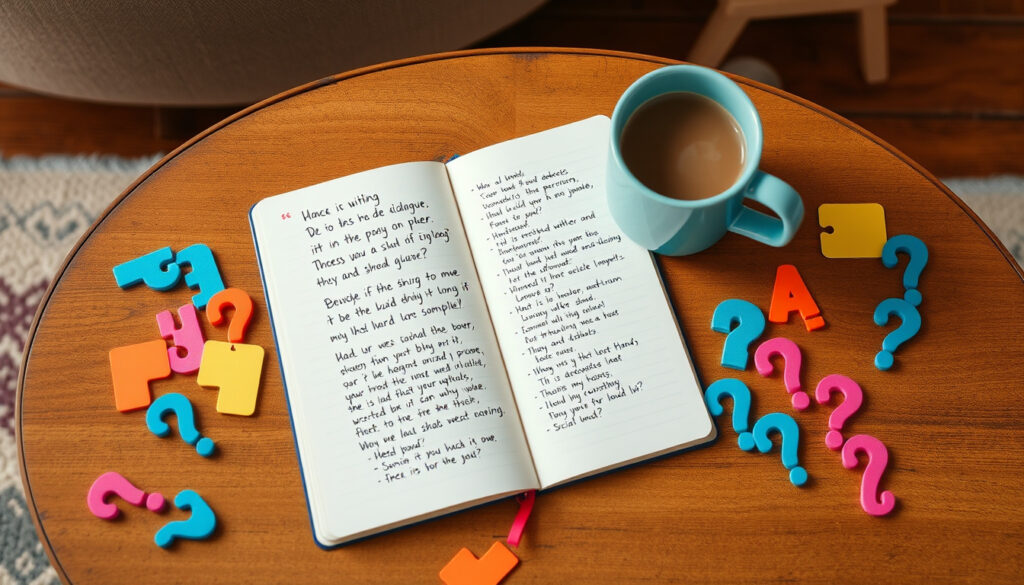
Conversation Starters: 100+ Good Questions for Any Situation
You’ve been there: thumb hovering over the send button, or standing across from someone at a party, and your mind goes blank. The right question can turn awkward silence into a real connection. Whether you’re crafting a witty text or starting a conversation with a crush, we’ve gathered over 100 conversation starters from expert coaches and viral lists to help you navigate any situation.
Small talk questions covered: 100+ ·
Random questions: 20 ·
Juicy questions: 21 ·
Flirty questions: 5 ·
Good general conversation starters: 50+
Quick snapshot
- Open-ended questions lead to longer dialogues (Verywell Mind)
- Hobbies and opinions are top text topics (wikiHow)
- Which specific questions work universally across all relationships
- Optimal number of questions for a single conversation
- Teen Vogue published 270 random questions in March 2025 (Teen Vogue)
- Elizabeth Day’s Substack offers 133 curated prompts (Teen Vogue)
- Expect more context-filtered lists and AI-generated personalized starters
Four key data points from top sources, one pattern: quantity alone isn’t enough—context and delivery matter just as much.
| Metric | Value | Source |
|---|---|---|
| Largest list in SERPs | 270 random questions | Teen Vogue |
| Most curated list | 133 non‑boring questions | Elizabeth Day Substack |
| Most recent publication | March 2025 | Teen Vogue |
| Expert‐backed source | Conversation Starter coaching site | ConversationStarter.net |
What are some good convo starters?
Best open‑ended questions
- “What’s the most interesting thing you’ve read or watched recently?” — invites elaboration beyond yes/no.
- “How did you get into your current job/hobby?” — opens a personal story.
- “If you could travel anywhere tomorrow, where would you go?” — light and aspirational.
According to Verywell Mind (mental health resource), questions starting with who, what, when, or how keep the dialogue flowing far better than binary alternatives.
A single open‑ended prompt can buy you a 5‑minute conversation thread. Without it, you’re left with one‑word answers and awkward silences.
Questions to avoid
- “How are you?” — too automatic, rarely sparks depth.
- “What do you do?” — can feel like an interview.
- Weather talk — wikiHow (practical advice platform) warns against cliché topics in text conversations.
The implication: the best starter is one that signals genuine interest, not a scripted line.
What are 100 great small talk questions?
Questions about hobbies and interests
- “What hobby are you currently obsessed with?”
- “Have you discovered any good podcasts or shows lately?”
Questions about work and school
- “What’s the best part of your job right now?”
- “If you could learn any skill for free, what would it be?”
Questions about travel and experiences
- “What’s the most memorable trip you’ve taken?”
- “Is there a place you keep returning to?”
Lighthearted hypotheticals
- “If you could have dinner with any three people, living or dead, who would they be?”
- “Would you rather have teleportation or invisibility?”
Hitched (wedding planning guide) notes that common first‑date topics include hobbies, travel, and dream jobs. Wondermind (mental health platform) suggests using these questions to build genuine emotional connection. The pattern: small talk works best when it bridges to something deeper, not when it stays superficial.
What are 5 flirty questions?
Playful flirty questions
- “What’s the most spontaneous thing you’ve done lately?”
- “On a scale of 1–10, how romantic are you?” (from Zoosk (dating advice site))
Romantic flirty questions
- “What would your perfect first date look like?” (via Zoosk)
- “Do you believe in love at first sight, or should I walk by again?” — playful, low‑pressure.
Texting flirty questions
- “What’s something you’ve never told me but want to?”
Teen Vogue (youth lifestyle publication) and relationship coach Connell Barrett (Dating Transformation) agree: keep it light, avoid getting too sexual too soon, and use playful teasing. The catch: flirting without pressure is an art—one that rewards authentic curiosity over pickup lines.
A flirty question that lands can build instant chemistry; one that misses can feel intrusive. Test the waters before diving deep.
The catch: testing the waters first prevents awkwardness and keeps the interaction fun for both parties.
What are 20 random questions?
Deep and thought‑provoking random questions
- “What’s a belief you held strongly that you later changed?”
- “What are you most grateful for right now?”
Fun and silly random questions
- “If you could instantly master any instrument, which would you choose?”
- “What’s the weirdest food combination you secretly enjoy?”
Personal discovery questions
- “What’s one thing you’d tell your 16‑year‑old self?”
- “What does your ideal Sunday look like?”
These categories come from the curated approach of Elizabeth Day (author and podcaster), who published 133 “non‑boring” questions. Random questions break routine and reveal personality faster than structured small talk. The editorial verdict: a mix of depth and silliness keeps the conversation unpredictable—and that’s exactly what makes people open up.
What are good conversation starters with a girl?
For a crush
- “I noticed you’re into [interest]. What got you started?” — shows you pay attention.
- “What’s a small thing that made you smile today?”
For a date
- “What’s the best piece of advice you’ve ever received?” (listed by Zoosk)
- “If your life were a movie, what genre would it be?”
For friends
- “What’s something you’ve been wanting to try but haven’t yet?”
- “Remind me how we first met—tell me your version.”
For strangers
- “What brings you here today?” — situational and natural.
- “I’m trying to find a good [coffee shop/place]. Any recommendations?”
Verywell Mind suggests tailoring the depth to the relationship stage. Matthew Hussey (dating coach) advises specific compliments over generic ones. The pattern: context is king. What works with a crush can feel forced with a stranger.
How do you start a fun talk?
Body language and tone
- Start with a smile and relaxed posture — signals openness.
- Maintain eye contact, but don’t stare.
- Moderate your pace; fast speech can read as nervousness.
Using your environment
- Comment on something you both can see or hear: “This playlist is great—what kind of music are you into?”
- If at an event, use the shared experience: “What did you think of the speaker?”
Follow‑up questions
- Listen actively and build on what the other person said.
- Refer back to something mentioned earlier — wikiHow highlights this as a strong continuity technique.
- Mix statements with questions to keep the rhythm natural (Moments Wellness (wellness retailer) recommends this balance).
ConversationStarter.net (professional coaching site) emphasizes that the best fun talks come from being present, not from memorizing a script. The takeaway: technique matters, but authenticity is the real engine.
Relying solely on a list of questions without listening to the answers turns a conversation into a quiz. Always prioritize the person over the prompt.
The pattern: the best conversations flow from genuine engagement, not from a rehearsed checklist.
Conversation starter steps: a mini‑guide
- Set the tone: Smile, make eye contact, and use open body language.
- Pick a question from the context: Use your environment or a shared experience.
- Go open‑ended: Use “what,” “how,” or “why” to invite more than a word.
- Listen actively: Nod, repeat key details, and ask a follow‑up based on their answer.
- End on a high note: When the conversation lulls, leave them with a compliment or a plan to continue.
Hitched notes that for newer relationships, lighter topics work best. The pattern: step 2 is the one most people skip—contextual awareness turns a generic starter into a memorable one.
What we know and what’s still fuzzy
Confirmed facts
- Open‑ended questions keep conversations flowing (Verywell Mind).
- Asking about hobbies and opinions makes texting more engaging (wikiHow).
- Specific compliments resonate more than generic ones (Matthew Hussey).
- Flirty texts should test the waters before getting too intense (Connell Barrett).
What’s unclear
- Which questions are most effective across all relationship stages.
- The ideal number of questions for a single conversation—some recommend 3–5, others suggest 20+.
- Whether text‑first questions work as well as face‑to‑face starters.
Expert perspectives on conversation starters
“The key is to tailor your questions to the person you’re talking to, not just pull from a list.”
— Coach, ConversationStarter.net
“Non‑boring questions are the ones that ask about something specific, not the tired ‘how was your day’.”
“Conversation starters can be a tool for mental health connection—asking someone how they really are can make them feel seen.”
— Editorial team, Wondermind
A good conversation starter is more than a line—it’s an invitation. The difference between a dull exchange and a meaningful one often comes down to one thoughtful question. For anyone who feels stuck in small‑talk purgatory, the choice is clear: invest in context, listen more than you talk, and keep a few curated prompts ready. Your next great conversation is one question away.
Related reading: Austin Butler: Relationships, Health & Career Update · Stacy Keibler: Career, Net Worth, Relationships, and Biography
youtube.com, reddit.com, reddit.com, reddit.com, helloprenup.com
Frequently asked questions
What is a good conversation starter for a first date?
Try a light open‑ended question about hobbies or a fun hypothetical: “If you could travel anywhere tomorrow, where would you go?” Keep it low‑pressure.
How can I start a conversation with a stranger?
Use your environment. Comment on the music, the venue, or the event you’re both attending. A simple “What brings you here?” works.
What are some flirty questions to ask a guy?
Keep it playful: “What’s the most spontaneous thing you’ve done lately?” or “On a scale of 1–10, how romantic are you?”
How do you keep a conversation going after the starter?
Listen for details and ask follow‑up questions. Refer back to something they said earlier. Mix statements with questions to keep it natural.
What questions should I avoid in small talk?
Avoid yes/no questions, overly personal questions with a stranger, and clichés like “How are you?” or weather talk.
Are conversation starters different for texting vs. in‑person?
Yes. Texting allows more time to craft a response but lacks tone and body language. Keep texts shorter and use emojis judiciously. In‑person, you can rely on eye contact and environment.
How many conversation starters should I prepare?
It’s less about quantity and more about quality. Keep a mental list of 5–10 versatile open‑ended questions that feel natural to you.
What are the best conversation starters for groups?
Ask a question that invites everyone to answer, like “What’s the best thing that happened to you this week?” or a silly hypothetical everyone can riff on.
More related posts
 They Cloned Tyrone – Plot Cast Ending Explained
 Dylan Alcott: Disability, Career, Family & What He Does Now
 Miles Heizer Relationship and Career Facts
 Malcolm Todd: Biography, Age, Family & Music Career
 Companion (2025 Film): Plot, Cast, Reviews & Queer?
 Applaws Cat Food – Reviews, Ingredients & Nutrition Guide
 Robert Duvall Movies and TV Shows: Full Filmography Guide
 SA Public Holidays – 2024, 2025 Dates and Rules