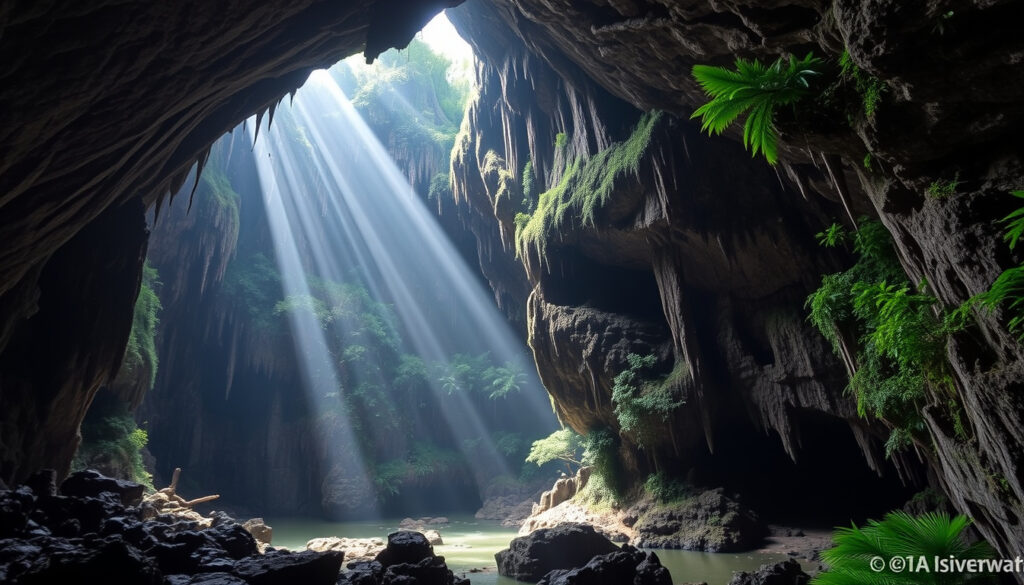
Hang Son Doong Tour: Cost, Size & How to Visit
Few natural wonders command the combination of awe, exclusivity, and physical commitment that Hang Son Doong demands. The world’s largest cave by volume—38.5 million cubic meters—sits hidden in the jungles of central Vietnam, and only about 1,000 people get to see it each year.
Total length: ~9 km (5.6 miles) ·
Largest cross-section: 200m × 150m (656ft × 492ft) ·
Total volume: 38.5 million cubic meters ·
Annual visitors: ~1,000 max ·
Tour operator: Oxalis Adventure (sole authorized operator)
Quick snapshot
- $3,000 per person for 4 days (Lonely Planet travel guide)
- Includes permits, guides, equipment, meals (Lonely Planet travel guide)
- No 1-day option available (Lonely Planet travel guide)
- Largest cave by volume (38.5 million m³) (Local Vietnam guide)
- Mammoth Cave is longer (600+ km) (Local Vietnam guide)
- Son Doong has the biggest single passage (Local Vietnam guide)
- Zero deaths since tour operations began in 2013 (Roo Wanders travel report)
- Only 1,000 visitors per year (Roo Wanders travel report)
- Sole operator: Oxalis Adventure (Lonely Planet destination guide)
- Hike 16 km per day on uneven terrain (per Oxalis Adventure official requirements)
- Swim across underground rivers (Oxalis Adventure official requirements)
- Must be in excellent health (Oxalis Adventure official requirements)
Before diving into the details, here are the essential specs you need to know.
| Attribute | Value |
|---|---|
| Location | Phong Nha-Ke Bang National Park, Quang Binh Province, Vietnam |
| Length | ~9 km (5.6 miles) |
| Maximum depth | 150 m |
| Discovery | 1990 by Ho Khanh; first explored by British Cave Research Association in 2009 |
| Tour duration | 4 days, 3 nights |
| Annual visitors | ~1,000 max |
The permit system and physical demands create a very specific type of visitor profile.
Why is Hang Son Doong so expensive?
At roughly $3,000 per person, a Hang Son Doong expedition costs more than a round-the-world plane ticket. That price tag shocks most first-time readers — and it deserves a real explanation.
Tour cost breakdown: permit, guides, equipment
- About $620 of the fee goes directly to the upkeep of Phong Nha-Ke Bang National Park, per the Lonely Planet expedition guide.
- The remainder covers a team of cave experts, safety assistants, cooks, porters, all meals, camping gear, and safety equipment — the same source notes that the crew-to-visitor ratio is roughly 2:1.
- Oxalis Adventure, the sole operator authorized by the Vietnamese government, must fly in supplies and haul out all waste.
Limited visitor numbers and conservation fees
- The government caps annual visitors at 1,000 — a number set to protect the cave’s delicate ecosystem, according to Roo Wanders travel coverage.
- Each group is limited to 10 guests, meaning the per-person cost of the support infrastructure is high by design.
What is included in the expedition price
- Pickup and drop-off in Dong Hoi, all meals, camping gear, guide fees, safety equipment, and park entrance fees.
- Not included: airfare to Vietnam, hotels in Dong Hoi, or travel insurance that covers evacuation.
The $3,000 price isn’t a luxury markup — it’s a conservation fee disguised as a tour. Every dollar funds the protection of a cave system that would otherwise face the same degradation seen in less-regulated natural wonders.
The implication: the high cost is the very mechanism that keeps the cave intact. Fewer visitors, higher price, better preservation.
Can I visit Hang Son Doong?
Yes — but you can’t just show up at the trailhead. Access is tightly controlled by a single operator, and the window is narrow.
- Book through Oxalis Adventure — the sole government-approved operator. Secure your spot 6–12 months ahead.
- Submit medical clearance — a signed physician’s form confirming you can handle 16 km daily hikes.
- Prepare physically — train with weighted packs on uneven terrain before departure.
- Pack personal gear — hiking boots, quick-dry clothing, headlamp, waterproof backpack.
- Arrange travel — book international flights to Vietnam plus domestic connection to Dong Hoi.
Booking through Oxalis Adventure
- Expeditions are managed exclusively by Oxalis Adventure (the sole government-approved operator).
- Tours run from January to August, according to Trekking Tours Sapa’s travel guide.
- Bookings often fill up a year or more in advance — the September 2024–August 2025 season sold out months ahead.
Physical fitness and experience requirements
- Participants must be able to hike 16 km per day over rough, uneven terrain.
- The route includes swimming across underground rivers and scrambling over boulder fields.
- A medical clearance is required; Oxalis reserves the right to turn away anyone who doesn’t meet the fitness standard.
Best time of year to visit
- January through August is the dry season in Quang Binh Province.
- The cave’s internal river rises during the wet season (September–December), making the route impassable for safety reasons.
This isn’t a casual day trip. If you’re not comfortable hiking 16 km a day with a 10 kg pack on uneven terrain in high humidity, Son Doong will punish you — and the guides will send you back.
What this means: the expedition is as much a physical filter as a financial one. Both are intentional.
Is Hang Son Doong or Mammoth Cave bigger?
This question produces more arguments in caving forums than almost any other. The answer depends entirely on whether you measure by volume or by length.
Volume comparison
- Hang Son Doong holds the record for largest single cave passage by volume at 38.5 million cubic meters, as measured by the National Geographic exploration team using laser instruments.
- Mammoth Cave’s total passage volume is spread across 600+ km of tunnels, but no single chamber rivals Son Doong’s main passage.
Length vs. cross-section differences
- Mammoth Cave is the longest cave system in the world at over 600 km of mapped passage, per the U.S. National Park Service (official government source).
- Hang Son Doong’s main passage reaches 200 meters in height and 175 meters in width, according to Local Vietnam’s detailed guide.
- Travel + Leisure Asia reports the main passage stretches at least 4 miles and reaches 655 feet high and 490 feet wide.
Six key points of comparison, one pattern: Son Doong wins the “wow factor” per square meter; Mammoth wins the “total area explored” contest.
The table below lays out the numbers side by side.
| Metric | Hang Son Doong | Mammoth Cave |
|---|---|---|
| Volume | 38.5 million m³ (largest single passage) | Distributed across 600+ km |
| Length | ~9 km | 600+ km (longest in the world) |
| Largest passage | 200m × 150m | Rotunda — 40m across |
| Annual visitors | ~1,000 (capped) | ~500,000+ |
| Tour cost | $3,000 (4-day expedition) | $0–$25 (self-guided or ranger tour) |
| Access model | Exclusive, permit-based | Open, public national park |
The pattern: Son Doong is the single most dramatic chamber on Earth; Mammoth is the sprawling underground continent. They’re leaders in different categories.
How much does it cost to visit Hang Son Doong?
The headline number is $3,000, but the real cost depends on where you’re flying from and what you count.
Standard 4-day expedition price
- The 4-day, 3-night expedition costs approximately $3,000 per person as of 2024, confirmed by Lonely Planet’s expedition breakdown.
- Some sources frame the same trip at 72 million VND (roughly $3,000), per Trekking Tours Sapa.
Additional costs: flights to Phong Nha, accommodation
- International flights to Vietnam (typically Hanoi or Ho Chi Minh City) are not included.
- A domestic flight or train from Hanoi to Dong Hoi adds $50–$150.
- Pre- and post-expedition hotels in Dong Hoi are not covered.
What the tour cost covers
- All meals, camping gear, guide fees, safety equipment, park entrance fees, and the $620 conservation contribution to Phong Nha-Ke Bang National Park, per the Lonely Planet guide.
- It does not include travel insurance, personal trekking gear, or alcohol.
For a traveler from the U.S. or Europe, the all-in cost (flight + tour + hotels + gear) lands between $4,500 and $5,500. That’s a once-in-a-decade trip, not a weekend getaway.
Why this matters: the sticker price is only half the story. The real question is whether the experience justifies the full investment — and for most who go, the answer is yes.
How many people have died in Son Doong Cave?
Zero. Since Oxalis Adventure began leading official tours in 2013, there have been no recorded fatalities on Son Doong expeditions.
Safety record of the Son Doong expedition
- No tourist deaths have occurred — a record that stands out in adventure travel, especially given the cave’s remote location and underground river crossings.
- Oxalis Adventure follows strict safety protocols: each group is accompanied by trained cave guides, safety assistants, and a dedicated medical kit.
Emergency procedures and rescue plans
- The cave has a subterranean river that requires experienced guides to navigate safely.
- Satellite phones and emergency evacuation plans are in place for the duration of the expedition.
- Participants must sign a waiver and provide medical clearance before departure.
The implication: the zero-death record isn’t luck — it’s the result of a permit system that prioritizes safety over volume. Compare that to open-access caves where accidents are far more common.
What is the Son Doong Cave 1 day tour?
No such thing exists. There is no 1-day tour for Hang Son Doong, and there never will be — the logistics and safety requirements make it impossible.
Day tours available for Phong Nha-Ke Bang caves
- Shorter tours visit nearby caves like Paradise Cave or Phong Nha Cave, which are accessible on a day trip from Dong Hoi.
- These cost between $30 and $100 and offer a taste of the region’s karst landscape without the multi-day commitment.
Why a 1-day tour cannot access Son Doong
- The hike to the cave entrance alone takes several hours from the trailhead.
- The full route requires camping inside the cave system for two nights.
- The distance and safety protocols — including river crossings, climbing sections, and emergency contingencies — demand a minimum of 4 days.
The trade-off: if you’re short on time, you can see other stunning caves in the park. But Son Doong requires a full expedition mindset — four days of total commitment.
Timeline: How Hang Son Doong became the world’s largest cave
Six key dates, one narrative: a local discovery, a scientific confirmation, and a carefully managed opening to the world.
| Year | Event |
|---|---|
| Local man Ho Khanh discovers the entrance of Hang Son Doong while foraging in the jungle. | |
| A team from the British Cave Research Association joins Ho Khanh to explore the cave, revealing its record-breaking size. | |
| Oxalis Adventure begins offering official guided tours, limited to 1,000 visitors per year. Government approval for access was granted the same year, per Lonely Planet’s destination history. | |
| Hang Son Doong is officially recognized as the world’s largest cave by volume. | |
| A scientific expedition discovers a new branch of the cave, extending its known length. |
The pattern: from a single man’s discovery to a globally recognized natural wonder, the timeline reveals a deliberate pace — one that prioritizes protection over exploitation.
Confirmed facts vs. what’s still unclear
Confirmed facts
- Hang Son Doong is the world’s largest cave by volume (38.5 million m³). (Local Vietnam guide)
- Oxalis Adventure is the sole authorized tour operator. (Lonely Planet destination guide)
- Zero tourist fatalities have occurred on official tours since 2013.
- Tour cost is approximately $3,000 per person. (Lonely Planet expedition guide)
What’s unclear
- Exact extent of newly discovered branches is still being mapped — the 2019 find may extend the cave further.
- Future price changes or permit policies are not publicly forecast.
What the explorers and guides say
“I was walking in the forest looking for timber when I felt a strong wind coming from behind a rock. I pushed aside some vines and saw a huge opening with clouds pouring out of it.”
— Ho Khanh, local discoverer of Hang Son Doong, as told to National Geographic (exploration magazine)
“When we first entered, we knew immediately it was something special. The passage was so large that a Boeing 747 could fly through it without touching the walls.”
— Howard Limbert, British caving expert and lead of the 2009 exploration team, in interviews with National Geographic
“The cave has its own weather system. Clouds form inside the main passage, and you can feel the temperature change as you walk through different sections.”
— Oxalis Adventure guide, quoted in Travel + Leisure Asia (travel publication)
The real takeaway
Hang Son Doong is not a tourist attraction — it’s a natural phenomenon that requires a combination of budget, fitness, and patience that most travelers will never assemble. For the adventure traveler who can meet those three conditions, the experience is genuinely unmatched: a 38.5-million-cubic-meter chamber with its own weather system, explored in the company of a handful of other people, with a safety record that speaks for itself. For the casual visitor who wants to see a big cave, the nearby Paradise Cave offers a taste of the same karst landscape for a fraction of the cost and effort. The choice isn’t about which is better — it’s about which kind of traveler you are.
The pattern: Hang Son Doong rewards the prepared traveler with an experience no other cave on Earth can match. For everyone else, the region’s other caves offer accessible alternatives without the $4,500+ price tag.
trekkingtoursapa.com, mrlinhadventure.com, lonelyplanet.com, sondoongcave.info, journeyrouters.com, theculturetrip.com
Frequently asked questions
How do I book a Hang Son Doong tour?
Book directly through Oxalis Adventure’s website. You’ll need to submit a medical clearance form and pay a deposit. Spots are limited and often sell out 6–12 months in advance.
What is the cancellation policy for Son Doong expeditions?
Oxalis Adventure has a tiered cancellation policy. Deposits are generally non-refundable, but partial refunds may be available if you cancel more than 60 days before the expedition. Check the current terms on the Oxalis website.
Can children visit Hang Son Doong?
No. The minimum age for the expedition is 18 years old, and all participants must be in excellent physical condition. The terrain and river crossings are not suitable for younger hikers.
What equipment do I need for the Son Doong hike?
Oxalis provides all camping and safety gear (tent, sleeping bag, helmet, harness, life jacket). You need to bring your own hiking boots, quick-dry clothing, a headlamp, and a waterproof backpack. A full packing list is provided after booking.
How long in advance do I need to book?
Most travelers book 6–12 months ahead. The September–August season sells out quickly, especially for the January–March window when weather is best. Check the Oxalis Adventure website for current availability.
Is the Son Doong tour suitable for beginners?
Not in the traditional sense. You don’t need prior caving experience, but you must be physically fit — able to hike 16 km per day on uneven terrain, swim, and carry a day pack. Previous hiking experience is strongly recommended.
What happens in case of bad weather during the expedition?
Oxalis monitors weather conditions and may delay or cancel expeditions if the cave’s river rises to unsafe levels. In such cases, alternative arrangements or refunds are offered. Safety is the primary concern.
More related posts
 James Brolin Biography: Age, Net Worth, Health, and Marriage
 Jessica Osbourne: Why She Skipped Ozzy’s Funeral, Private Life
 Companion (2025 Film): Plot, Cast, Reviews & Queer?
 OLED vs QLED – 2025 Comparison Guide
 Michael Caton: Parkinson’s, His Tiny Castle Salary, and Life Now
 Kelsea Ballerini Biography: Songs, Relationships, Net Worth
 Emily Dickinson: Biography, Poems, and Taylor Swift Link
 2025 NRL Ladder After Round 12: Raiders, Bulldogs Top