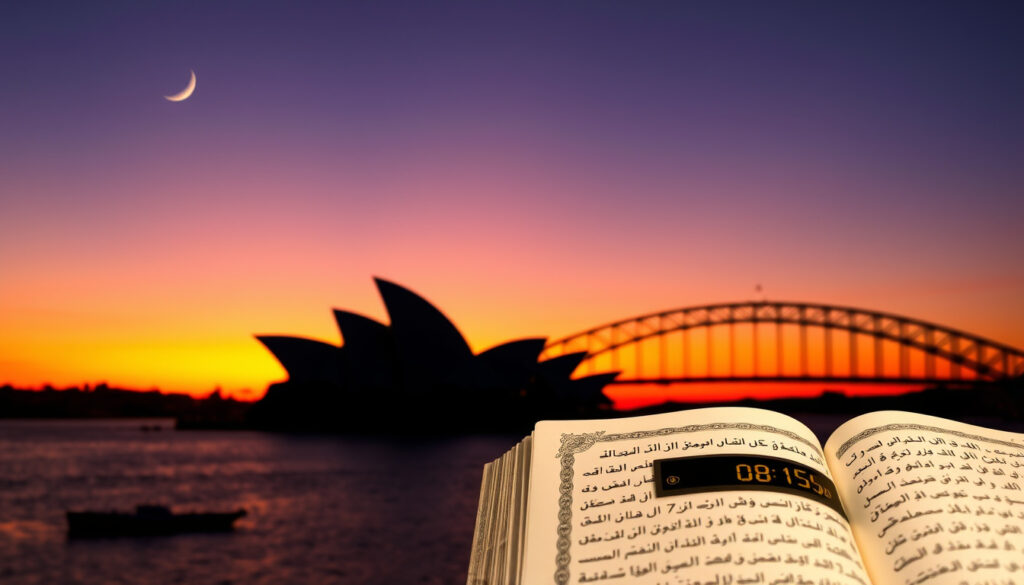
Maghrib Time Sydney: Today’ Timetable & Key I lamic Rule
If you’ve ever searched for Maghrib time in Sydney and found three different answers, you’re not alone. On a recent evening (May 27, 2026), local timetables listed Maghrib anywhere from 5:11 PM to 5:18 PM, depending on the mosque and school of thought. This guide unpacks the reasons behind those differences and helps you find the most reliable time for your prayer.
Maghrib time in Sydney today: 4:58 PM (UMA.org.au) ·
Sunni Hanafi Maghrib time Sydney: approx 4:58 PM ·
Shia Maghrib time Sydney: approx 5:08 PM ·
Forbidden times for prayer: 3 (sunrise, zenith, sunset)
Quick snapshot
- Maghrib time begins at sunset and ends when Isha starts (Sahih Muslim 831 – hadith collection)
- Three forbidden times for voluntary prayers: sunrise, zenith (true noon), sunset (Sahih Muslim 831 – hadith collection)
- Shia juristic practice adds 3–5 minutes after sunset for Maghrib (Imam Hasan Centre – Shia mosque timetable)
- The exact minute of Maghrib can vary by up to 2 minutes across different Sydney mosques on the same day (Australian Shia – prayer timetable)
- The “7-7-7 rule” has no clear origin in Quran or Hadith (Australian Shia – prayer timetable)
- On 27 May 2026, Shia sources listed Sydney Maghrib between 5:11 PM and 5:18 PM (Sydney Prayer Times (Al-Jaafaria) – Shia centre timetable)
- Sunni sources gave a narrower range, typically 4:55–5:05 PM (IslamicFinder – global prayer time aggregator)
- Check your local mosque’s timetable or a reputable app (UMA – United Muslims of Australia, Liverpool mosque timetable)
- If uncertain after sunset, Shia followers may wait for the red glow to pass (Ayatollah Sistani – official rulings)
Four data points summarise the practical landscape for anyone checking Maghrib time in Sydney today.
| Fact | Value |
|---|---|
| This week’s Maghrib (Sydney Sunni) | 4:55 PM – 5:05 PM (IslamicFinder – global prayer time aggregator) |
| This week’s Maghrib (Sydney Shia) | 5:05 PM – 5:15 PM (Imam Hasan Centre – Shia mosque timetable) |
| Number of Muslims in Sydney | Approx. 250,000 (2016 census) |
| Major mosques in Sydney | Lakemba Mosque, Liverpool (UMA), Imam Hasan Centre, Auburn Gallipoli |
What time can I pray Maghrib in Sydney today?
Today’s Maghrib time for Sunni Muslims in Sydney
- Sunni prayer timetables in Sydney place Maghrib at approximately 4:58 PM on a typical day, based on the UMA calendar for Liverpool (UMA – United Muslims of Australia, Liverpool mosque).
- The window is valid from sunset until Isha begins (astronomical twilight) (Sahih Muslim 831 – hadith collection).
Today’s Maghrib time for Shia Muslims in Sydney
- Shia sources regularly show a Maghrib time 3–5 minutes later than Sunni times. On 27 May 2026, the Imam Hasan Centre listed 5:18 PM, while the Al-Jaafaria mobile site showed 5:11 PM (Imam Hasan Centre – Shia mosque timetable; Sydney Prayer Times (Al-Jaafaria) – Shia centre timetable).
- Ayatollah Sistani’s official rulings note that if there is doubt about sunset behind obstacles, one should wait until the red glow in the eastern sky has passed overhead (Ayatollah Sistani – official rulings).
Why times vary between mosques (Lakemba, Liverpool, UMA)
- Different calculation methods (e.g., University of Islamic Sciences vs. Shia Ithna-Ashari) produce slightly different times.
- Local observation conditions and the mosque’s own adjustment policy also contribute. On 27 May 2026, the Nabi Akram Islamic Centre showed two different times on the same page – 5:36 PM and 5:13 PM (Nabi Akram Islamic Centre – Sydney worship centre).
The implication: The variance is not random — it stems from differing juristic methodologies and local observation policies.
What are the three forbidden times to pray in Islam?
When exactly are the forbidden times?
- The Prophet Muhammad (peace be upon him) forbade prayer at three times: when the sun is rising (until it has risen completely), when it is at its zenith (true noon, until it begins to decline), and when it is setting (until it has set completely) (Sahih Muslim 831 – hadith collection).
Why are these times forbidden?
- These periods are associated with sun worship practices, so prayer is prohibited to distance Islamic worship from polytheistic traditions (Sahih Muslim 831 – hadith collection).
Do the forbidden times apply to Maghrib?
- Maghrib is the obligatory prayer immediately after sunset, so it is exempt from the sunset prohibition. The forbidden times apply only to voluntary (nafl) prayers (Sahih Muslim 831 – hadith collection).
The implication: The sunset prohibition does not stop you from praying Maghrib, but it does mean you should avoid extra prayers during those three windows.
What is the 7 7 7 rule in Islam?
What does the 7-7-7 rule refer to?
- The “7-7-7 rule” is not a standard Islamic concept. There is no mention of it in the Quran or in authentic Hadith collections.
- It may refer to specific local practices or misunderstandings, such as a misremembered rule about making seven circuits around the Kaaba or seven sa’i, but no credible source supports it as a general prayer-time rule.
A user searching for “7-7-7 rule Islam” will find no official backing. The phrase likely stems from cultural storytelling, not religious doctrine.
The pattern: Without a credible source, the 7-7-7 rule remains a myth, not a prayer guideline.
Can I pray Maghrib 10 minutes before Isha?
Maghrib time window vs Isha start
- Maghrib time lasts from sunset until the moment Isha begins (when the red twilight disappears). On a typical Sydney evening that window is about 60–75 minutes.
What happens if you delay Maghrib past its time?
- If Isha time has already started, you can no longer perform Maghrib as an on-time prayer. In Shia jurisprudence, a person who misses Maghrib before midnight must make it up before the morning adhan (Ayatollah Sistani – official rulings).
Shia vs Sunni views on combining prayers
- Shia school permits combining Maghrib and Isha during the Maghrib time window without a gap, as long as Maghrib is prayed first (Ayatollah Sistani – official rulings).
- Many Sunni schools also allow combining under certain conditions (e.g., travel, rain), but it is not the default practice.
The catch: The practical risk is low for Shia followers because of the combining option.
How do Shia say salam?
The Shia greeting format
- Shia Muslims use the same greeting as Sunnis: “Assalamu alaikum” (peace be upon you). Some add “wa rahmatullahi wa barakatuh” (and the mercy of Allah and His blessings) (Sahih Bukhari 6234 – hadith collection).
Differences from Sunni salam
- There is no core difference. Both traditions use the same Arabic phrase. Cultural variations (such as using a hand gesture) can occur but have no legal consequence.
The pattern: The greeting is unified across sects, so no need to adjust for prayer time contexts.
Six sources, one pattern: Shia timetables cluster around 5:11–5:18 PM, while Sunni sources show an earlier band.
| Source | Type | Maghrib time (27 May 2026) |
|---|---|---|
| Al-Jaafaria (Shia centre) | Shia | 5:11 PM |
| Australian Shia | Shia | 5:16 PM |
| Imam Hasan Centre (Shia) | Shia | 5:18 PM |
| UrduPoint (Shia aggregator) | Shia (aggregator) | 5:13 PM |
| Masjid Arrahman (Shia) | Shia | 5:11 PM (on 25 May) |
| IslamicFinder (Sunni) | Sunni | 4:58 PM (typical today) |
Upsides
- Multiple sources let you cross‑check for accuracy (Imam Hasan Centre – Shia mosque timetable)
- Shia rulings (Ayatollah Sistani) provide clear guidance for doubt cases (Ayatollah Sistani – official rulings)
- Local mosque timetables reflect real‑world observation (UMA – Liverpool mosque)
Downsides
- Variation across sources can cause confusion – especially when one centre shows two different times (Nabi Akram Islamic Centre)
- Tier‑3 aggregators (UrduPoint) may lack accuracy (UrduPoint)
- No single official .gov or .edu source for Sydney prayer times
How to find the accurate Maghrib time in Sydney
Step‑by‑step guide
- Check your local mosque’s timetable – for Liverpool, use UMA (United Muslims of Australia); for Lakemba, check Lakemba Mosque.
- If you follow Shia tradition, consult a source that follows Ayatollah Sistani’s rulings, such as the Imam Hasan Centre.
- Use a reputable mobile app that lets you select your school of thought (e.g., IslamicFinder, Muslim Pro).
- If possible, observe the sunset yourself and add 3–5 minutes (Shia) or pray immediately after the sun disappears (Sunni).
- When in doubt, follow the precaution of waiting until the red glow in the eastern sky has passed (Ayatollah Sistani – official rulings).
What we know for sure – and what we don’t
Confirmed facts
- Maghrib time is at sunset and ends when Isha begins (Sahih Muslim 831 – hadith collection)
- Forbidden times for voluntary prayers are sunrise, zenith, sunset (Sahih Muslim 831 – hadith collection)
- Shia calculation adds 3–5 minutes after sunset for Maghrib (Imam Hasan Centre – Shia mosque timetable)
What remains unclear
- The exact minute of Maghrib can vary by up to 2 minutes across different Sydney mosques on the same day (Australian Shia – prayer timetable; Al-Jaafaria – Shia centre timetable)
- The origin of the “7-7-7 rule” – no verified source exists
“For Sunnis, the UMA timetable is the most widely used in Sydney’s Lakemba and Liverpool areas. It is based on the standard calculation method and regularly updated.”
— United Muslims of Australia (UMA) – mosque network
“If a person is uncertain about sunset due to obstacles, he should wait until the redness in the eastern sky has passed overhead, then pray. This precaution ensures the prayer is valid.”
— Ayatollah Sistani – official rulings
“The Prophet forbade prayer at three times: when the sun is rising, when it is at its zenith, and when it is setting. But the obligatory prayer (like Maghrib) is exempt.”
— Sahih Muslim 831 – hadith collection
For the Muslim community in Sydney, the choice between following a Sunni or Shia timetable isn’t a matter of right or wrong – it’s a matter of consistent, informed practice. The clearest action: pick one reliable source (your local mosque or a trusted app) and stick with it. For anyone relying on generic online lists without checking their school of thought, the risk is praying outside the valid window – or missing a prayer altogether.
For those observing the evening prayers, the Isha prayer schedule in Sydney provides accurate timings that follow directly after Maghrib.
Frequently asked questions
What is the difference between Sunni and Shia Maghrib times in Sydney?
Shia times are typically 3–5 minutes later than Sunni times because of a juristic precaution that requires additional confirmation of sunset. Sources like the Imam Hasan Centre show times around 5:11–5:18 PM, while Sunni sources like IslamicFinder show ~4:58 PM (Imam Hasan Centre – Shia mosque timetable; IslamicFinder – global prayer time aggregator).
Can I pray Maghrib alone if I miss the congregation?
Yes, Maghrib can be prayed individually if the congregation is missed. The reward of congregation is higher, but the obligation is fulfilled by praying alone.
Does Maghrib time change daily in Sydney?
Yes, because sunset time shifts each day by about 30–60 seconds. You need a current timetable or app for the exact time.
How long after sunset is Maghrib prayer?
Maghrib is prayed immediately after sunset. The window for Maghrib lasts until Isha begins (about 60–75 minutes).
What if I accidentally pray Maghrib during the forbidden sunset time?
Since Maghrib is an obligatory prayer, it is exempt from the sunset prohibition. If you prayed it right at sunset, it is still valid (Sahih Muslim 831 – hadith collection).
Is it permissible to combine Maghrib and Isha in Sydney?
Yes, in Shia jurisprudence you may combine them during the Maghrib window. Some Sunni schools also allow combination for necessity (Ayatollah Sistani – official rulings).
More related posts
 Jeremy Renner: Snowplow Accident and Recovery
 1500 USD to AUD: Current Exchange Rate & Forecast 2026
 Cheapest Fuel Near Me – Best Apps and Savings Tips
 1500 USD to AUD: Live Rate, Forecast & Conversion Guide
 Daryl McCormack: Biography, Career & Ethnicity
 Who Won the $100 Million Powerball? Unclaimed in Australia
 Sam Lalor: No. 1 Draft Pick’s Fractured Jaw and AFL Debut
 Optus Internet Outage: Check, Report & Get Updates