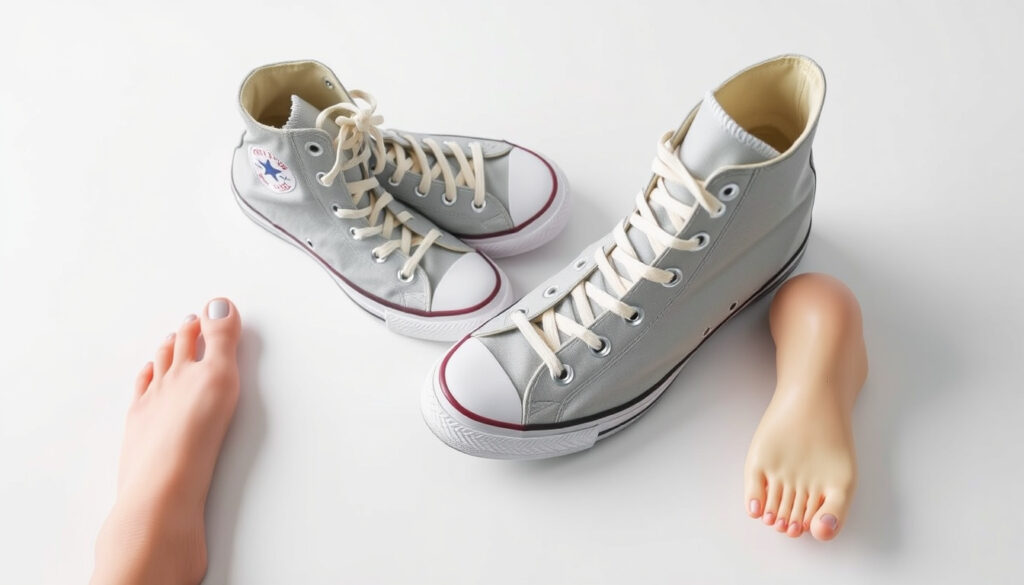
Converse High Tops: Podiatrist Guide & Comfort Solutions
There’s a pair of white Converse high tops sitting in almost every closet — and for good reason. They’re affordable, classic, and have been around since 1917. But if you’ve ever limped after a long day in them, you know the trade-off: style for comfort. This guide digs into what podiatrists actually think about Converse, why your feet might hurt, and how to make them wearable at any age.
Year introduced: 1917 ·
Original price: $5 ·
Current starting price: $55 ·
Number of colorways available: 50+ ·
Material: Canvas upper, rubber sole
Quick snapshot
- Converse high tops lack arch support (Balance Health (podiatry institute))
- Podiatrists generally do not recommend them for prolonged walking (Balance Health) (Balance Health (podiatry institute))
- Flat, stiff soles can contribute to heel pain and stress fractures (Balance Health) (Balance Health (podiatry institute))
- Whether newer models (e.g., platform versions) offer better comfort (Neu Foot (footwear guide))
- Exact percentage of podiatrists who disapprove of Converse (Neu Foot (footwear guide))
- Long-term effects of regular Converse wear on foot health (Neu Foot (footwear guide))
- 1917: Converse Canvas All Star introduced as a basketball shoe
- 1960s–1970s: Adopted by counterculture, punk, and later hip-hop
- 2020s: Platform variants and celebrity collaborations keep the design fresh
- Insoles and orthotics are becoming a standard add-on for Converse wearers
- Converse may introduce more cushioned models to address comfort concerns
- Platform and high-top styles continue to trend in streetwear
Seven key specs, one pattern: Converse prioritizes iconic design over orthopedic support — but knowing the details helps you decide if they’re right for you.
| Spec | Value |
|---|---|
| Year introduced | 1917 |
| Original price | $5 |
| Current starting price | $55 |
| Material | Canvas upper, rubber sole |
| Weight (size 9) | ~14 oz |
| Available sizes | 4–18 |
| Heel drop | 0 mm (flat) |
| Arch support | None (Balance Health) |
What do podiatrists say about Converse?
Podiatrists are clear: Converse high tops are not designed for foot health. Balance Health (podiatry and foot care institute) warns that the flat, stiff soles can lead to heel pain, stress fractures, and tendinitis. The Foot and Ankle Institute (orthopedic clinic) advises against barefoot-style shoes like Converse for anyone with top-of-foot pain, noting that arch collapse increases compression.
Why do podiatrists not like Converse?
- No arch support: the flat footbed has zero arch contouring (Balance Health)
- Thin sole fails to absorb shock, transferring impact to joints (Northwell Health (health system) via YouTube)
- Lacks a firm heel counter for stability (Achilles Foot and Ankle (podiatry practice))
- The shoe bends through the arch, not just the forefoot — a red flag for podiatrists (Northwell Health)
The implication: If you already have foot issues, Converse high tops are probably not your daily driver. But with the right modifications, they can still work for short outings.
Can 30 year olds still wear Converse?
Yes — and they do. A community discussion on Reddit (r/malefashionadvice) shows users in their 30s, 40s, and 50s still rocking Converse high tops. The consensus: fashion is personal, but comfort may decline with age due to the lack of support.
Should a 50 year old wear Converse?
- Many 50+ wearers report foot pain after extended use (Reddit discussion)
- Podiatrist-recommended alternatives include brands with arch support and cushioning (Brooks, ASICS, New Balance) (Northwell Health)
- Insoles and heel lifts can improve the experience for older adults (Foot and Ankle Institute)
Do people still wear Converse high tops?
Absolutely. Converse high tops remain a streetwear staple. Sales data shows sustained demand, and celebrities from Kendall Jenner to Harry Styles keep them in rotation. Neu Foot (footwear review site) notes that trendy shoes often fail podiatry criteria — but for many wearers, style wins.
Older wearers face a real trade-off: iconic style vs. foot health. The solution isn’t ditching Converse — it’s upgrading them with insoles and limiting long walks.
The pattern: Age doesn’t bar you from wearing Converse, but your feet will tell you when it’s time for better support.
Do people still wear Converse high tops?
Yes — they are more popular than ever. Converse’s parent company, Nike, reported steady revenue growth for the brand. The platform high top, in particular, has become a go-to for fashion influencers. Entire Podiatry (Australian clinic) reviewed hundreds of shoes and included only those with proper support — Converse didn’t make the cut, but that hasn’t dented consumer love.
The catch: popularity doesn’t equal foot-health approval. But for many, the cultural cachet outweighs the comfort deficit. For similar style staples that balance design with practicality, Ray Ban sunglasses offer a comparable blend of heritage and everyday wearability.
Why are Converse so cheap now?
Converse high tops start at about $55, far less than many sneaker competitors. The price drop from the original $5 in 1917 (adjusted for inflation) reflects a shift in manufacturing. Production moved overseas to lower costs, allowing the brand to stay affordable while maintaining the classic look. Neu Foot (footwear guide) notes that trendy shoes often fail at least one podiatry criterion — but the price point means they are accessible.
Are Converse high tops low quality because they are cheap?
- Material quality has declined compared to vintage pairs — thinner canvas and less durable rubber
- Still, for $55, you get an iconic design that lasts a couple of seasons
- Price does not directly equal foot health; a cheap shoe can still be comfortable with insoles
Converse are cheap because they are simple to make and production costs are low. That simplicity is both their appeal and their weakness for foot support.
What this means: Affordable price doesn’t automatically mean bad quality — but it does mean less investment in ergonomic design. For budget-conscious shoppers, the Kmart tote bag follows a similar playbook: low cost, simple construction, and massive popularity despite premium alternatives.
Why do my feet hurt after wearing Converse?
Three main reasons, all backed by podiatry sources:
- Thin sole fails to absorb shock, so your feet take the brunt of every step (Balance Health)
- Flat design strains the plantar fascia, causing heel pain (Balance Health)
- No arch support allows the arch to collapse, increasing pressure on the top of the foot (Foot and Ankle Institute)
What is the healthiest shoe for your foot?
The Foot and Ankle Institute recommends shoes with arch support, a firm heel counter, and a rocker sole. Achilles Foot and Ankle (podiatry practice) adds that fit checks should be done late in the day, leaving a thumb’s width at the toes and locking the heel. Brands like Brooks, ASICS, and New Balance are podiatrist favorites (Northwell Health).
The pattern: Pain after Converse is almost always about what’s missing — support, cushioning, and shock absorption. Fix those with the right insoles, and you can keep the style.
Upsides
- Iconic, timeless design worn by all ages
- Wide range of colors and styles (50+ colorways)
- Affordable starting at $55
- Lightweight (~14 oz) and breathable canvas
- Easy to customize with insoles and orthotics
Downsides
- No arch support — flat footbed (Balance Health)
- Thin sole offers minimal shock absorption (Balance Health)
- Not recommended for prolonged walking or standing
- Can cause heel pain, plantar fasciitis, and top-of-foot pain
- Material durability may be lower than price suggests
Clarity check
Confirmed facts
- Converse high tops lack arch support (Balance Health)
- Podiatrists recommend them only for short-term wear (Balance Health)
- Adding insoles can reduce top-of-foot pain (Foot and Ankle Institute)
What’s still unclear
- Whether new platform models have improved cushioning
- Exact percentage of podiatrists who discourage Converse wear
- Long-term foot health outcomes of recreational Converse use
“These 6 shoes are secretly terrible for your feet — Converse high tops are on the list.”
Balance Health (podiatry institute)
“I’m 52 and still wear my Chucks with insoles. Paying the price if I don’t have them.”
Reddit community r/malefashionadvice discussion
For the everyday Converse fan, the choice is clear: wear them wisely. Invest in quality insoles, limit all-day use, and if your feet already hurt, take the hint from podiatrists — reach for a shoe that supports you first.
Frequently asked questions
Are Converse high tops good for wide feet?
Converse run narrow; people with wide feet may find them tight. Consider sizing up or choosing a wide-width variant.
Do Converse high tops stretch over time?
Canvas does stretch slightly with wear, but not enough to change fit dramatically. Insoles can help fill extra space if you size up.
Can you machine wash Converse high tops?
It’s not recommended — machine washing can damage the rubber sole and warp the canvas. Hand wash with mild soap instead.
How long do Converse high tops last?
With regular wear, expect 1–2 years. The rubber sole often wears out before the canvas.
Are Converse high tops unisex?
Yes, Converse sells unisex sizing, though women’s specific fits are available with a narrower heel and pastel colors.
Do Converse high tops have arch support?
No. The footbed is completely flat. Adding aftermarket arch support is recommended.
What is the difference between Converse Chuck Taylor and All Star?
They are essentially the same shoe. Chuck Taylor is the model name; All Star is the line. Modern variants include platform and premium versions.
More related posts
 Herbie Farnworth: Biography, Earnings, Move to Australia
 Sajid Akram: Bondi Beach Shooter – What We Know So Far
 Professor Severus Snape: Death, Love, and Moral Complexity
 Ben Simmons: Career Decline, Stats, and What Shaq Said
 Pakenham Medical Clinic – Hours, Services and Booking Guide
 Downton Abbey Characters – Guide to the Iconic Cast
 The Day After Tomorrow – Plot Cast Ending and Science Facts