Richard III: Scoliosis, Descendants & Car Park Discovery
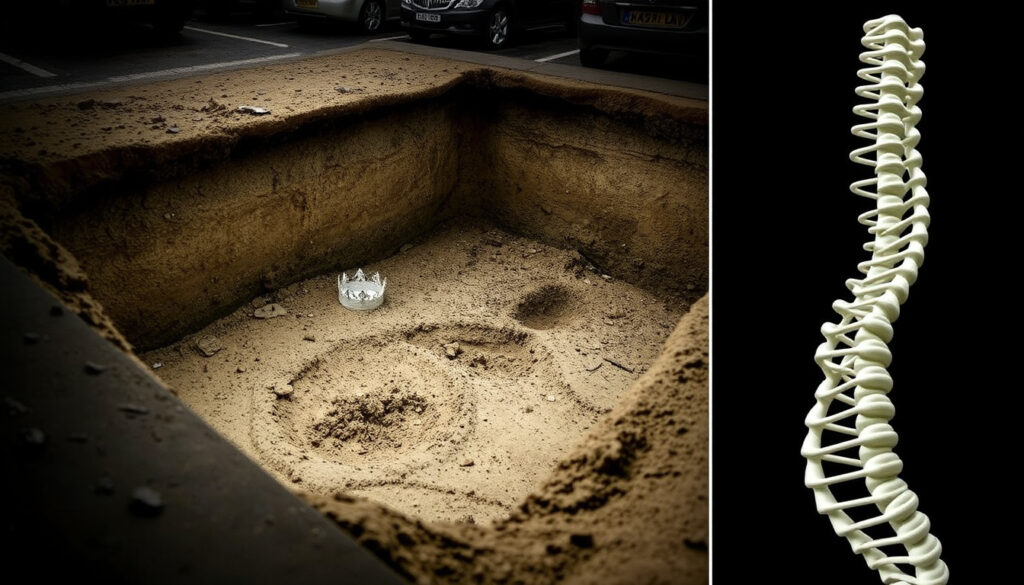
A king buried under a car park. That’s the kind of twist that makes you stop and wonder. Richard III, the last monarch of the Plantagenet dynasty, died in battle in 1485 and was hastily buried at Grey Friars in Leicester — a site that vanished from memory until 2012, when archaeologists dug beneath a parking lot and found him. The discovery didn’t just rewrite history books; it replaced centuries of Shakespearean caricature with cold, measurable facts about scoliosis, battle wounds, and living relatives.
Reign: 26 June 1483 – 22 August 1485 ·
Death: Battle of Bosworth Field, 22 August 1485 ·
Age at death: 32 ·
Height: ~5 ft 8 in (1.73 m) ·
Scoliosis curvature: ~70–80 degrees ·
Known living descendants: Yes (collateral lines)
Quick snapshot
- Last Plantagenet king of England, reigned 1483–1485 (BBC News (UK broadcaster))
- Defeated and killed at the Battle of Bosworth Field (Nature Communications (peer-reviewed journal))
- Skeleton found in 2012 under a Leicester car park (BBC News (UK broadcaster))
- Whether Richard III ordered the murder of the Princes in the Tower (History Extra (history magazine))
- Whether he planned to marry his niece Elizabeth of York (BBC News (UK broadcaster))
- Exact circumstances of his death wounds (Springer (medical publisher))
- Born 1452 at Fotheringhay Castle (BBC News (UK broadcaster))
- Killed in battle 1485, buried at Grey Friars (Nature Communications (peer-reviewed journal))
- Remains rediscovered in 2012, confirmed by DNA in 2013 (National Geographic (science publisher))
- Continued debate over DNA testing of Princes in the Tower bones (History Extra (history magazine))
- Further research into Richard’s scoliosis and health (Springer (medical publisher))
- Ongoing genealogical studies of collateral descendants (CBS News (US broadcaster))
Eight key facts, one pattern: the man behind the myth is now grounded in skeletal evidence, not Tudor propaganda. The data table below confirms the raw biographical details.
| Attribute | Detail |
|---|---|
| Full name | Richard III of England |
| Born | 2 October 1452, Fotheringhay Castle |
| Died | 22 August 1485, Bosworth Field |
| Burial | Grey Friars, Leicester (rediscovered 2012) |
| Spouse | Anne Neville |
| Children | Edward of Middleham (died young) |
| Cause of death | Battle wounds |
| Height | Approximately 5 ft 8 in (1.73 m) |
Why is Richard III so famous?
Shakespeare’s portrayal
Richard III’s image as a evil, crippled usurper comes largely from William Shakespeare’s 1592 play, which was written under Tudor patronage. Shakespeare depicted Richard as a “poisonous bunch-backed toad” who murdered his way to the throne. The play’s portrayal cemented Richard as one of history’s great villains, but it drew heavily on Tudor propaganda designed to legitimize Henry VII’s claim. National Geographic (science publisher) notes that the real skeleton tells a different story.
The Princes in the Tower
Richard’s most infamous alleged crime is the disappearance of his young nephews, Edward V and Richard of Shrewsbury, who were lodged in the Tower of London in 1483 and never seen again. Historical consensus remains divided. History Extra (history magazine) reports that no contemporary source directly accuses Richard, and the princes’ fate is still debated.
Last English king killed in battle
Richard III holds the distinction of being the last English monarch to die on the battlefield. He was killed at the Battle of Bosworth Field on 22 August 1485, fighting against the army of Henry Tudor. The BBC News (UK broadcaster) reports that his body was stripped and carried back to Leicester on a horse.
Shakespeare’s villain is not the man the bones reveal. The skeleton shows a king who was physically capable of fighting — and he did fight, taking 11 perimortem injuries before dying.
The implication: Richard III’s fame is a blend of genuine historical significance and Tudor-era spin. The archaeological evidence now allows us to see past the caricature.
What disability did Richard III have?
Scoliosis diagnosis from the skeleton
The skeleton found in 2012 under a Leicester car park revealed severe scoliosis — a sideways curvature of the spine. BBC News (UK broadcaster) reported that the condition would have made one shoulder higher than the other, but it did not prevent Richard from leading a cavalry charge. A 2019 review in Springer (medical publisher) described the curvature as ~70–80 degrees.
Debunking the hunchback myth
Shakespeare’s “hunchback” is a dramatic exaggeration. The 2019 review confirmed that the skeleton had no kyphosis (forward curvature) typical of a hunchback. Instead, the scoliosis caused a rotational asymmetry that would have been visible as a shoulder height difference, but not a hump. Nature Communications (peer-reviewed journal) noted that the spine was curved, not bent.
Richard III had a real spinal condition, but it was not the grotesque deformity Shakespeare described. The skeleton shows a man who was physically active and died in combat, not a cripple.
The trade-off: the myth of the hunchback served Tudor propaganda, but the truth is more nuanced — and more human.
Are there any living descendants of Richard III?
Collateral descendants identified
Yes, living collateral descendants exist. Researchers used mitochondrial DNA from female-line relatives to identify the skeleton. CBS News (US broadcaster) reported that Michael Ibsen and Wendy Duldig were identified as living descendants through Anne of York, Richard’s eldest sister. The University of Leicester team confirmed a perfect mitochondrial DNA match. Nature Communications (peer-reviewed journal) reported a 99.999% probability of identity.
Benedict Cumberbatch connection
Actor Benedict Cumberbatch is a second cousin 16 times removed through Richard III’s sister. History Extra (history magazine) notes that Cumberbatch even recited a poem at the 2015 reburial service. There are no direct descendants from Richard’s own line, as his only son, Edward of Middleham, died young.
The pattern: the living descendants are collateral — through Richard’s siblings — not his own children. Yet the DNA chain is extraordinarily strong, with a 99.999% probability that the bones are Richard III’s, according to National Geographic (science publisher).
What happened to Richard III after he died?
Burial at Grey Friars
After his death at Bosworth Field, Richard III’s body was taken to Leicester and buried at the Grey Friars Priory. The location was recorded in historical accounts, but the priory was dissolved in 1538 and its exact site was lost. BBC News (UK broadcaster) reports that the friary was eventually covered by a car park.
Rediscovery in 2012
In August 2012, the University of Leicester Archaeological Services excavated the Grey Friars site, now a parking lot. They found a skeleton with battle wounds and scoliosis. On 4 February 2013, researchers announced that DNA from the skeleton matched living descendants, confirming the identity. Nature Communications (peer-reviewed journal) published the full genetic analysis in 2014.
Reburial in Leicester Cathedral in 2015
On 26 March 2015, Richard III’s remains were reinterred in Leicester Cathedral in a ceremony attended by descendants and dignitaries. History Extra (history magazine) notes that the reburial ended a 530-year journey from battlefield to cathedral.
The catch: the rediscovery was a triumph of modern archaeology, but it also highlighted how much was lost — the friary’s records, the exact location of the grave, and the original burial marker.
Timeline
- 1452 — Richard III born at Fotheringhay Castle (BBC News (UK broadcaster))
- 1483 — Becomes King of England (History Extra (history magazine))
- 1485 — Defeated and killed at the Battle of Bosworth Field, buried at Grey Friars (Nature Communications (peer-reviewed journal))
- 2012 — Skeleton excavated under a Leicester car park (BBC News (UK broadcaster))
- 2013 — Skeleton confirmed to be Richard III via DNA (CBS News (US broadcaster))
- 2015 — Reburial in Leicester Cathedral (History Extra (history magazine))
Clarity: Confirmed vs. Unclear
Confirmed facts
- Richard III’s skeleton has scoliosis — BBC News (UK broadcaster)
- He died at Bosworth Field in battle — Nature Communications (peer-reviewed journal)
- Collateral descendants exist (e.g., Benedict Cumberbatch) — CBS News (US broadcaster)
- His remains were discovered under a car park in Leicester — BBC News (UK broadcaster)
What’s unclear
- Whether he ordered the murder of the Princes in the Tower — History Extra (history magazine)
- Whether he planned to marry his niece Elizabeth of York — BBC News (UK broadcaster)
- The exact circumstances of his death (specific wounds) — Springer (medical publisher)
Quotes from the experts
“The skeleton was found beneath a Leicester car park on the site of the former Grey Friars church.”
— University of Leicester archaeologists, via BBC News (UK broadcaster)
“The search for Richard III’s remains was a long shot, but the evidence was overwhelming — the DNA match, the scoliosis, the battle wounds — all pointed to the same conclusion.”
— Philippa Langley (historian and lead investigator of the Looking for Richard project), via National Geographic (science publisher)
Related reading: **David Laid: Scoliosis, Height, Net Worth & More**
medieval.eu, culturalheritagethroughimage.omeka.net, en.wikipedia.org, the-past.com, sciencedaily.com
For a deeper look at the ongoing debate surrounding his life and death, explore Richard IIIs controversial legacy.
Frequently asked questions
Was Richard III really a hunchback?
No. The skeleton showed scoliosis, a sideways curvature, not a hunchback (kyphosis). Shakespeare’s portrayal exaggerated the deformity for dramatic effect. Springer (medical publisher) confirmed the curvature was ~70–80 degrees, but not a hump.
How was Richard III’s body identified?
Through mitochondrial DNA testing of the skeleton against living descendants, combined with radiocarbon dating, osteological analysis, and Bayesian statistics. The probability of identity was 99.999%. Nature Communications (peer-reviewed journal) published the full genetic analysis.
Where was Richard III buried originally?
At Grey Friars Priory in Leicester, after his death at Bosworth Field. The priory was later dissolved and the site became a car park, rediscovered in 2012. BBC News (UK broadcaster) reports the excavation.
Did Richard III kill the princes in the tower?
There is no direct evidence linking Richard to the murder of Edward V and Richard of Shrewsbury. The case remains circumstantial, and historians are divided. History Extra (history magazine) notes that no contemporary source accuses him.
Is there any movie about Richard III?
Yes, several films feature Richard III. The most famous is the 1995 film Richard III starring Ian McKellen, set in a fictional 1930s fascist England. There is also the 1955 film with Laurence Olivier.
Who succeeded Richard III as king?
Henry Tudor, who became Henry VII after defeating Richard at the Battle of Bosworth Field. He married Elizabeth of York, uniting the houses of York and Lancaster.
What was Richard III’s cause of death?
Battle wounds sustained at Bosworth Field. The 2019 medical review in Springer (medical publisher) identified 11 perimortem injuries, including a fatal blow to the skull.
For historians and the British public, the rediscovery of Richard III’s remains under a Leicester car park resolved a 500-year-old mystery, but it also left open the most tantalizing question: what really happened to the Princes in the Tower? The DNA evidence is there — but the Church of England has not granted permission for testing. Until that changes, the full story of the last Plantagenet king remains unfinished.
More related posts
 MacBook Pro M4: Specs, M4 Pro Comparison & Lifespan
 Mt Hotham Ski Resort Guide: Location, Snow, and Comparisons
 Colin Fassnidge: Cocaine Driving Case & Career Update
 Hugo Ekitike: Biography, Stats, and Comparisons
 Violet McGraw: Age, Sister, Movies & Facts, Not Twins
 Julie Andrews Today: Age, Health, Family & Where She Lives (2025)
 Jimmy Fallon: Biography, Family, Net Worth, Controversies
 Spencer Leniu: Bio, Injury, Salary, ADHD & Roosters Future