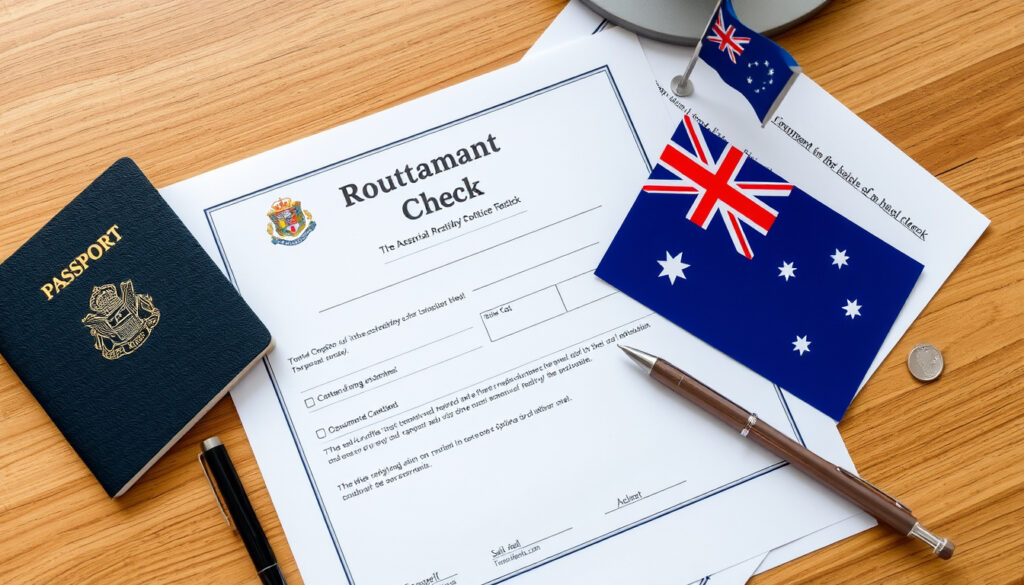
Police Check Australia: Cost, Apply & Documents
If you’ve ever needed a police check in Australia, you’ve probably wondered why there’s no single, straightforward answer. Between the AFP’s National Police Certificate, state-level checks, and different rules for overseas applicants, it can get confusing. This guide covers the costs, documents, and application steps so you can get the right check without the headache.
Standard cost of an Australian police check: AUD $42 (AFP) · Typical processing time: 10–15 business days · Validity period: 12 months (commonly requested) · Online application availability: Yes, via AFP Converga portal · Free police check available: No general free option; limited exemptions
Quick snapshot
- AFP charges AUD $42 for a National Police Certificate (Australian Federal Police)
- Standard processing is 10–15 business days (AFP)
- 100 points of ID required (AFP)
- Exact overseas processing times vary by embassy and postal delays (AFP)
- Whether a state check is accepted nationally is case-dependent (AFP)
- Future fee changes are not announced in advance (AFP)
- AFP digital certificates: most arrive within a few days (AFP)
- Fingerprint checks: at least 15 working days (AFP)
- Victoria Police state checks: 7–10 business days (unofficial estimate) (AFP)
- Apply online via AFP Converga portal or by post (AFP)
- Gather 100 points of ID and scan documents (AFP)
- Check progress through the AFP portal (AFP)
| Standard fee (AFP) | AUD $42 |
| Typical turnaround | 10–15 business days |
| Validity period | 12 months (common employer requirement) |
| Online application | Yes, via AFP Converga portal |
| Free checks available | No general free option |
| Overseas applicant route | Through Australian embassy or AFP online |
The table above shows the AFP route is the cheapest official option, but state checks and third-party providers offer different trade-offs.
How do I apply for an Australian police check from Ireland?
Application through the Australian Embassy in Dublin
- The Australian Embassy in Ireland provides guidance on obtaining a police clearance certificate (Australian Federal Police (national authority)).
- Embassy staff can confirm whether you need a name-based or fingerprint-based certificate (CVCheck (ACIC-accredited provider)).
- Applications are forwarded to the AFP for processing.
Applying online via the AFP portal
- You can apply for an AFP National Police Certificate online through the Converga portal (AFP).
- Payment is made by card at the time of application (AFP).
- Most digital certificates arrive within a few days for straightforward applications (AFP).
Mailing fingerprint-based applications
- If a fingerprint check is required, online application is not available (AFP).
- Fingerprint checks take at least 15 working days (AFP).
- Completed forms must be sent within 3 months of signing (AFP).
The implication: overseas applicants face longer waits and additional steps. Start your application at least 6 weeks before you need the certificate.
Online applications are faster but fingerprint checks are mandatory for many visa categories. The AFP warns that you cannot lodge a National Police Check application at a police station (AFP) – it’s online or post only.
What documents do I need for a police check in Australia?
Primary identification documents
- A combination of 100 points of ID is required (AFP).
- Passport, Australian driver licence, and birth certificate are common primary documents (AFP).
- Applicants must include all names they have been known by (AFP).
Secondary identification documents
- Medicare card, bank statement, and utility bills are accepted as secondary ID (AFP).
- If documents are not in English, official translations are required (AFP).
Digital identity verification options
- Online verification via myGovID or the Document Verification Service (DVS) is accepted (Veritas Check (ACIC-accredited provider)).
- You need a scanner or mobile device with camera to upload documents (Veritas Check).
What this means: gather your primary ID first, then use secondary items to reach 100 points. Many applicants overlook the need for official translations – that can stall your application.
How long will it take to get a police check in Australia?
Standard processing times
- The AFP states 10–15 business days for most National Police Certificate applications (AFP).
- State police checks may be faster – Victoria Police processes in about 7–10 days (unofficial).
- Some ACIC-accredited providers like Veritas Check return results within 24 hours for straightforward cases (Veritas Check).
Factors affecting delays
- Incomplete identification or name matches can cause delays (AFP).
- Fingerprint checks add at least 15 working days (AFP).
- Applications cannot be processed if payment or documents are missing (AFP).
Expedited options
- No formal expedited service exists for AFP checks (AFP).
- Third-party accredited providers may offer faster turnaround for a higher fee – Veritas Check claims 24 hours for most results (Veritas Check).
The trade-off: paying a bit more to an accredited provider can cut weeks off the wait, but the AFP route is the official standard and typically accepted everywhere.
How much does an Australia police check cost?
AFP National Police Certificate fees
- The current AFP fee for a National Police Certificate is AUD $42 (AFP).
- Payment online by card; by post via bank cheque or money order (AFP).
State police check pricing
- Victoria Police charges AUD $29.70 for a state check.
- State checks are often cheaper but may not be accepted by national employers (CVCheck).
Additional costs for fingerprint checks
- Fingerprint-based checks incur extra fees – approximately AUD $55 beyond the base fee (AFP).
- Third-party providers add processing fees – Veritas Check charges $63.00 AUD for a standard check and $23.00 AUD for volunteer/student checks (Veritas Check).
The pattern: the AFP is the cheapest official option at $42, but if you need speed or a hard copy, fees climb fast.
A standard AFP check costs $42, but add fingerprints ($55) and a hard copy ($9.95) and you’re over $100. For job seekers on a budget, that’s a real sting.
Is there a free police check in Australia?
Situations where police checks are free
- No general free police check exists – all official channels charge a fee (AFP).
- Volunteer roles may access free checks through Volunteering Australia or similar organisations.
- Some employers reimburse the cost, but the individual pays upfront.
Cost-saving alternatives
- Use the AFP directly ($42) rather than a third-party agent to avoid extra fees.
- Check if your employer or volunteer organisation has an accredited provider discount code.
- State police checks (e.g., Victoria $29.70) are cheaper if accepted for your purpose.
Why free checks are rarely available
- The AFP requires cost recovery for the National Police Checking Service (AFP).
- Identity verification and data matching systems are expensive to maintain.
The catch: “free” usually means someone else is paying. Without an employer or volunteer program, budget $42–$100 for your certificate.
Confirmed facts
- AFP charges AUD $42 for a National Police Certificate (2025 fee) (AFP).
- Standard processing is 10–15 business days (AFP).
- 100 points of ID are required (AFP).
- Police checks are not free for the general public (AFP).
What’s unclear
- Exact processing times for overseas applications vary by embassy and postal delays (AFP).
- Whether a specific state check will be accepted by a national employer is case-dependent.
- Future fee changes are not announced in advance.
“A National Police Certificate (NPC) is a summary of your offender history in Australia.” – Australian Federal Police (national police authority)
“Police clearance certificates issued on the basis of fingerprints or a name check.” – Australian Embassy Ireland (official guidance)
Summary
Getting a police check in Australia is straightforward if you know the right path: for most people, the AFP National Police Certificate at $42 and 10–15 business days is the safest bet. But if you need it fast, a third-party accredited provider can deliver in 24 hours for $63. For overseas applicants, start early and plan for fingerprint delays. For job seekers on a tight timeline, the choice is clear: pay a little more for speed, or accept the wait and save the difference. For more information on police checks in Australia, visit $downunderbrief.org.
For a detailed walkthrough of the process, refer to this national police check guide which covers costs and required documents.
Frequently asked questions
What is a National Police Certificate?
A National Police Certificate (NPC) is a document issued by the Australian Federal Police that summarises any disclosable court outcomes from all Australian states and territories (AFP).
Can I get a police check for a visa application?
Yes, many visa categories require a police clearance. The AFP provides certificates specifically for visa purposes; fingerprint-based checks are often mandatory (AFP).
Do I need a police check if I am applying for a working holiday visa?
It depends on the country. Working holiday visa applications from some nations require a police certificate; check the Department of Home Affairs website for your specific case.
How does an AFP police check differ from a state police check?
An AFP check covers all Australian jurisdictions, while a state check only covers that state. National employers usually require the AFP certificate (CVCheck).
Can I use a police check from overseas in Australia?
Generally no. Australian employers and visa authorities require an Australian-issued police check (AFP).
What happens if my police check shows a disclosable court outcome?
The certificate will list the outcome. Employers and visa authorities assess relevance to your role or application; a disclosable outcome does not automatically disqualify you.
Does a police check expire?
Police checks do not have an official expiry, but most employers and organisations require one issued within the last 12 months (AFP).
How do I check the progress of my application?
Online applicants can check status through the AFP Converga portal. Postal applicants should contact the AFP directly with their reference number (AFP).
More related posts
 Andrew Lincoln’s Walking Dead Exit: Family Over Fame
 Peking Duk: Members, Hits, and Breakup Rumors Explained
 Aluminium vs uPVC Sliding Doors: Irish Homeowner Guide
 Sam Lalor: No. 1 Draft Pick’s Fractured Jaw and AFL Debut
 Best NBN Internet Plans: Compare Broadband Deals & Providers
 David Laid: Scoliosis, Height, Net Worth & More
 5G Home Internet Ireland: Compare Providers & Plans
 Tyriq Withers: Biography, Height, Relationships, and Family