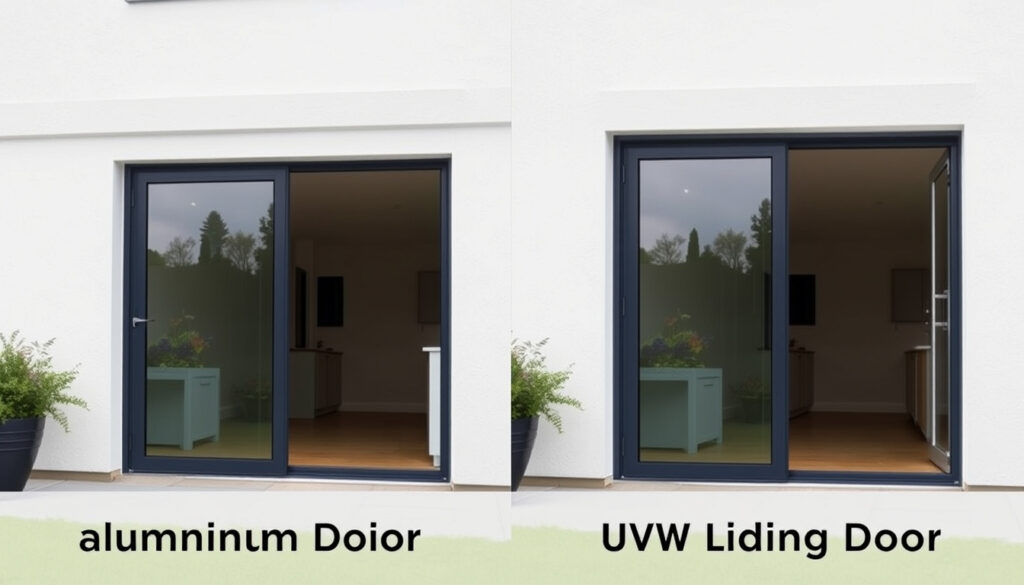
Aluminium vs uPVC Sliding Doors: Irish Homeowner Guide
Choosing between aluminium and uPVC sliding doors can feel like picking between style and sense – but for Irish homeowners, the decision runs deeper than that. This guide compares both materials on upfront cost, durability, thermal performance, and security, with real prices sourced from Irish installers and a clear breakdown of what works best in Ireland’s damp maritime climate. By the end, you’ll know exactly which material suits your home and budget.
Market share of uPVC in Ireland (2023): ~65% of new installations ·
Average installed cost of aluminium sliding door: €1,200 – €2,500 ·
Modern aluminium frame U-value: as low as 1.2 W/m²K with thermal break
Quick snapshot
- uPVC offers better thermal insulation than standard aluminium without thermal break (Atlas Aluminium)
- Aluminium frames are stronger and allow slimmer profiles and larger glass panels (Origin Global)
- Sliding doors commonly suffer from track debris and wheel wear over time, requiring periodic maintenance (Checkatrade)
- Exact market share split between materials in Ireland (no central registry exists)
- Long-term reliability of new thermal-break aluminium designs beyond 10 years
- Whether smart glass will become standard in sliding doors within the next decade
- Aluminium market share in Ireland grew from an estimated 15% to 35% between 2016 and 2025, driven by modern design preferences (industry estimates)
- Predicted: aluminium overtakes uPVC in new Irish builds by 2030 as thermal-break technology matures and costs narrow (Atlas Aluminium)
| Attribute | Value |
|---|---|
| Average sliding door cost in Ireland (installed) | €900 – €3,000 depending on size and material |
| Most common material choice in 2025 | uPVC ~65%, aluminium ~35% of new installations |
| Thermal insulation leader | uPVC (U-value 1.0–1.4 W/m²K) vs aluminium (1.2–1.8 W/m²K) |
| Durability leader | Aluminium (30–45 years) vs uPVC (20–30 years) – Origin Global |
| Recommended locking standard | Multi-point locking meeting PAS 24:2016 |
| Typical lifespan of uPVC door mechanism | 15–20 years before wheels require replacement |
The implication: aluminium leads on longevity, uPVC leads on insulation — your choice depends on which priority matters more.
What are the disadvantages of sliding doors?
Even the best sliding doors come with trade-offs. Here are the most common issues Irish homeowners report.
Common sliding door problems in Ireland
- Track alignment – Sliding doors can shift out of alignment, especially after ground settlement in Irish homes. Regular track cleaning is essential (Checkatrade).
- Dirt accumulation – Leaves and grit in the track cause wheels to wear faster. uPVC tracks are more prone to debris jamming than aluminium.
- Air leakage – Poorly installed sliding doors let drafts through. uPVC frames tend to seal better if fitted correctly (Atlas Aluminium).
Maintenance issues with sliding door tracks
Two problems, one pattern: track debris and wheel wear are the main reasons sliding doors become hard to open. Aluminium tracks resist corrosion better in coastal areas, but both need annual cleaning and lubrication.
Security concerns with sliding glass doors
Modern sliding doors with multi-point locks meet PAS 24:2016 forced-entry standards – but single-point locks remain common on budget uPVC models. Irish buyers should insist on multi-point locking regardless of material.
Which is better: aluminium or uPVC sliding doors?
This is the central question for Irish homeowners. We break it down across four dimensions.
Durability comparison: aluminium vs uPVC
Aluminium is structurally stronger and resists warping, while uPVC can warp in direct sunlight and is more prone to discolouration over time (Origin Global).
Thermal performance: aluminium vs uPVC
uPVC naturally provides better insulation, with U-values as low as 1.0 W/m²K. Aluminium without a thermal break can reach 1.8 W/m²K, but thermally broken aluminium systems now achieve 1.2 W/m²K (Atlas Aluminium).
Cost comparison: aluminium vs uPVC
| Material | Typical cost range (installed) | Long-term value |
|---|---|---|
| uPVC | €900 – €2,000 | Lower upfront, 20–30 year lifespan |
| Aluminium (standard) | €1,500 – €3,000 | Higher upfront, 40–50 year lifespan |
| Aluminium (thermal break) | €2,200 – €4,000 | Best lifespan + thermal performance |
The pattern: uPVC wins on price now; aluminium wins on total cost of ownership over 40 years (
More related posts
 Julianne Moore: Age, Husband, Movies, and Alzheimer’s Advocacy
 2 Pounds in kg – Exact Value, Formula and Tables
 Kevin Von Erich: Life, Career, and the Wrestling Dynasty
 Lucy Punch: Age, Husband, Children, and Career Facts
 Kristin Kreuk’s Husband, Baby, Ethnicity, and More
 Ras el Hanout – What It Is, Ingredients and How to Use
 Chemist Warehouse Hamilton: Contact, Hours, and Location
 David Fincher Movies: Full Filmography, Best Films & Oscars