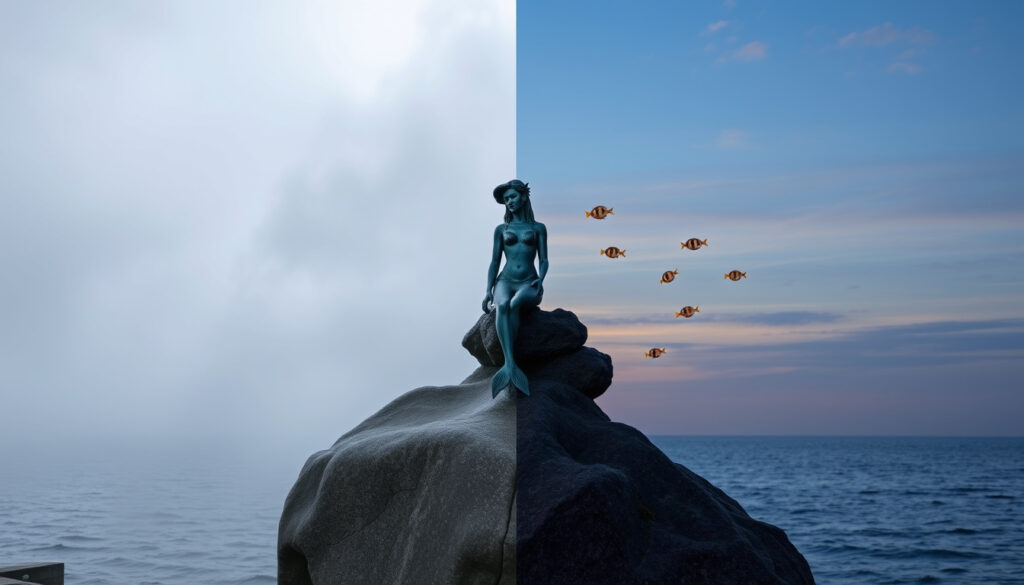
The Little Mermaid: Copenhagen Statue, Dark Original & Di ney
There’s a reason the Little Mermaid still sparks conversation more than 180 years after Hans Christian Andersen first wrote the story. From the quiet bronze statue in Copenhagen harbor to the exuberant Disney animation, this tale has never stayed in one shape.
Copenhagen statue unveiling: 1913 ·
Runtime (1989 film): 83 minutes ·
Original story author: Hans Christian Andersen (1837) ·
Domestic box office (1989): $111 million ·
Academy Awards won: 2 (Best Original Score, Best Original Song)
Quick snapshot
- The Copenhagen statue was unveiled in 1913 (Travel In Culture (travel history publication)).
- Andersen’s original 1837 story ends with the mermaid turning to sea foam (Grand European Travel (tour operator)).
- The statue is 1.25 m tall and weighs 175 kg (Wikipedia (free encyclopedia)).
- Sebastian is a crab (Wikipedia (free encyclopedia)).
- Ursula’s design was inspired by drag queen Divine (Wikipedia (free encyclopedia)).
- Whether Disney officially identifies Ursula as an LGBTQ character (not confirmed) (Wikipedia (free encyclopedia)).
- Whether the Jamaican accent for Sebastian is appropriate or offensive (debated) (Wikipedia (free encyclopedia)).
- Whether the statue in the harbor is a copy (some say original stored by Eriksen’s heirs) (KLM Travel Guide (airline destination content)).
- Whether the 2023 live-action film’s global box office of $569 million signals sustained franchise demand (not yet clear). (Wikipedia (free encyclopedia))
- Exact age appropriateness for very young children varies by sensitivity (no universal source). (Wikipedia (free encyclopedia))
- 1837: Andersen publishes the fairy tale (Travel In Culture).
- 1913: Statue unveiled in Copenhagen (Wikipedia).
- 1989: Disney animated film released (Wikipedia).
- Disney’s live-action franchise may continue with sequels.
- Academic discourse on feminist and queer readings grows.
- The Copenhagen statue remains a target for vandals and a canvas for protests.
Six facts that anchor the story across time and medium:
| Copenhagen statue year | 1913 |
|---|---|
| Original story author | Hans Christian Andersen |
| 1989 film runtime | 83 min |
| 2023 film box office (global) | $569 million |
| Sebastian species | Crab (not lobster) |
| Ursula vocal inspiration | Drag queen Divine |
What is the significance of The Little Mermaid in Copenhagen?
- The bronze statue at Langelinie was unveiled on 23 August 1913, commissioned by Carlsberg brewer Carl Jacobsen (Travel In Culture).
- Balleria dancer Ellen Price sat for the face; sculptor Edvard Eriksen used his wife Eline for the body (KLM Travel Guide (airline destination content)).
- The statue has been beheaded, bombed, and vandalized multiple times since 1964 (KLM Travel Guide).
What it means: Copenhagen’s little mermaid is less a gentle icon than a contested monument — loved by tourists, attacked by activists, and constantly reinterpreted. She sits at the intersection of national pride and political expression.
“The mermaid statue was commissioned as a gift by brewer Carl Jacobsen of Carlsberg Breweries.”
Travel In Culture (travel history publication)
The statue has become a Rorschach test for Danish identity: a 1.25‑m bronze that has survived decapitation, paint, and political protest, yet remains the city’s most photographed sight.
The implication: the statue’s endurance reflects its contested role as both a beloved landmark and a forced cultural object.
What is the original Little Mermaid story?
- Hans Christian Andersen wrote the tale in 1836 and published it in 1837 as part of “Fairy Tales Told for Children” (Travel In Culture).
- Unlike Disney’s version, Andersen’s mermaid does not win the prince; she dies and becomes sea foam (Grand European Travel (tour operator)).
- The story centers on unrequited love, sacrifice, and spiritual transformation rather than romantic triumph.
The implication: Disney’s happy ending is a fundamental rewrite. The original’s darkness — the pain of walking on knives, the loss of voice, the final dissolution — makes the tale a meditation on suffering, not a love story.
“Andersen’s original tale is a tragic story in which the mermaid gives up her voice for legs in order to pursue a prince… the prince marries someone else and the mermaid turns into sea foam.”
What is The Little Mermaid a metaphor for?
- Feminist readings see Ariel’s silence as a symbol of women being forced to suppress their voices for love (Grand European Travel).
- Scholars like Dr. Rebecca Hains interpret the story as a critique of patriarchal expectations on the female body and voice.
- Andersen’s original can also be read as a metaphor for unrequited queer love or the pain of being an outsider.
The catch: The metaphor shifts depending on which version you read. Andersen’s original points to spiritual salvation through suffering; Disney’s points to self-fulfillment through romance. Both offer commentary, but they land on opposite moral ground.
The Little Mermaid has been claimed by feminists, queer readers, and conservatives alike — each version becomes a mirror for the cultural anxieties of its time.
The pattern: each adaptation reinterprets the core metaphor, making the tale a flexible cultural lens.
Is Sebastian a crab or a lobster?
- Sebastian is explicitly a red Jamaican crab, despite being red like a lobster.
- Voice actor Samuel E. Wright gave him a Jamaican patois, which he developed for the role (Wikipedia (free encyclopedia)).
- The accent has sparked debate about cultural appropriation versus authentic Caribbean representation.
What this means: A seemingly silly question — crab vs. lobster — reveals deeper arguments about racial authenticity in Disney’s animated canon. Sebastian may be a minor character, but he carries a weight of representation he wasn’t designed for.
Is Ursula from The Little Mermaid LGBTQ?
- Ursula’s design was directly inspired by drag queen Divine (Wikipedia (free encyclopedia)).
- Her flamboyant mannerisms, exaggerated makeup, and campy delivery are textbook examples of queer coding in animation.
- Disney has never officially confirmed Ursula as an LGBTQ character in canon.
The trade-off: Queer coding lets audiences read Ursula as a queer icon, but it also traps her in the “flamboyant villain” stereotype. The 2023 live-action film didn’t change that — Ursula remains coded but unlabeled.
“Ursula’s character design was partially inspired by drag queen Divine.”
Wikipedia (free encyclopedia)
What age is The Little Mermaid 1989 appropriate for?
- MPAA rating: G (General Audiences) for the 1989 animated film.
- Common parental guidance age: 4+ for the animated version.
- Scenes like Ursula’s transformation may frighten very young children.
- Live-action 2023 rated PG for some scary images and thematic elements.
The bottom line: while the G rating suggests universal appeal, sensitivity varies by child. Parents should preview the darker sequences before showing to toddlers.
Timeline
- 1837: Hans Christian Andersen publishes “The Little Mermaid” fairy tale.
- 1913: Little Mermaid statue unveiled in Copenhagen harbor.
- 1989: Disney releases animated The Little Mermaid, launching the Disney Renaissance.
- 2008: Statue moved temporarily to Shanghai Expo.
- 2023: Disney releases live-action adaptation directed by Rob Marshall.
The pattern: Each milestone reinterprets the mermaid for a new audience, from tragic folk tale to corporate franchise to global landmark. The statue has been around longer than the film, yet the film now overshadows the original.
Clarity check
Confirmed facts
- The Copenhagen statue is a major tourist attraction.
- Andersen’s original story ends with the mermaid turning to sea foam.
- Sebastian is a crab.
- Disney’s 1989 film is rated G.
- Ursula’s design was inspired by Divine.
What remains unclear
- Whether Ursula is officially an LGBTQ character (Disney has not confirmed).
- Exact age appropriateness for all children (varies by child sensitivity).
- Whether Sebastian’s accent is offensive or appropriate (debated).
The takeaway: the known facts anchor the story, but the debates around representation and intent remain open.
For fans of the fairy tale, the Little Mermaid is no longer just a story — it’s a mirror reflecting our own evolving values, from gender roles to representation. The next adaptation will have to reckon with all the voices this little mermaid has inspired.
Frequently asked questions
How long is the Little Mermaid movie?
The 1989 animated film runs 83 minutes; the 2023 live-action version runs 135 minutes.
Where can I stream The Little Mermaid?
The 1989 film is available on Disney+; the 2023 live-action film streams on Disney+ as well.
What is the Little Mermaid 2023 cast?
Halle Bailey stars as Ariel, with Jonah Hauer-King as Prince Eric, Javier Bardem as King Triton, Melissa McCarthy as Ursula, and Daveed Diggs as the voice of Sebastian.
Is The Little Mermaid based on a true story?
No, it is a fictional fairy tale by Hans Christian Andersen, first published in 1837. No historical mermaid has been confirmed.
How much did The Little Mermaid 2023 cost to make?
The production budget was estimated at $250 million (Wikipedia (free encyclopedia)).
What are the new songs in the 2023 Little Mermaid?
Lin-Manuel Miranda co-wrote four new songs: “For the First Time,” “Wild Uncharted Waters,” “Scuttlebutt,” and “Daughters of Triton.”
Who voices Ursula in the 2023 live-action film?
Melissa McCarthy plays Ursula; the character’s songs are performed by McCarthy.
Related reading: LGBTQ readings of fairy tales · famous cultural landmarks guide
More related posts
 Tim English: AFL Player Profile, Salary, Injury Updates, and More
 Harper Beckham: Age, School, and Family Life in 2026
 Anna Nicole Smith: Her Life, Death, and Financial Legacy
 Jeremy Lindsay Taylor: Biography, Family, Home and Away Return 2025
 New Orleans Pelicans: NBA Team History, Roster & Schedule
 Africa Cup of Nations Games: Schedule and Controversies
 Mason Cox: Biography, Height, and 2026 Move to Fremantle
 Willie Rioli Retires: Career, Family & Name Change